Table of Contents
"I asked AI a question, it gave me a great answer — but I still had to do all the work myself." Sound familiar?
In 2026, the most talked-about concept in AI is the "AI agent." Unlike traditional chat AI that only responds when asked, AI agents take a goal, break it into steps, use tools, and complete the task autonomously. Gartner predicts that 40% of enterprise applications will embed AI agents by the end of 2026.
This guide explains what AI agents are, how they differ from traditional chatbots, what they can and cannot do, and which services lead the field in 2026.
1. What Is an AI Agent?
An AI agent is a program that takes a goal set by a human, autonomously breaks it into subtasks, uses the right tools, and verifies results to achieve that goal.
Traditional chat AI (early ChatGPT, basic chatbots) ends at "question → answer." AI agents, by contrast, autonomously repeat the following cycle:
- Perceive: Understand the goal and the current situation
- Decide: Determine the next best action
- Act: Operate external tools and APIs
- Verify: Check results and self-correct if needed
In short, if a chatbot is "AI that gives answers," an AI agent is "AI that gets work done."
Understanding generative AI and LLMs (Large Language Models) — the foundations of AI agents — helps clarify why agents became possible.
2. Chatbots vs. AI Agents
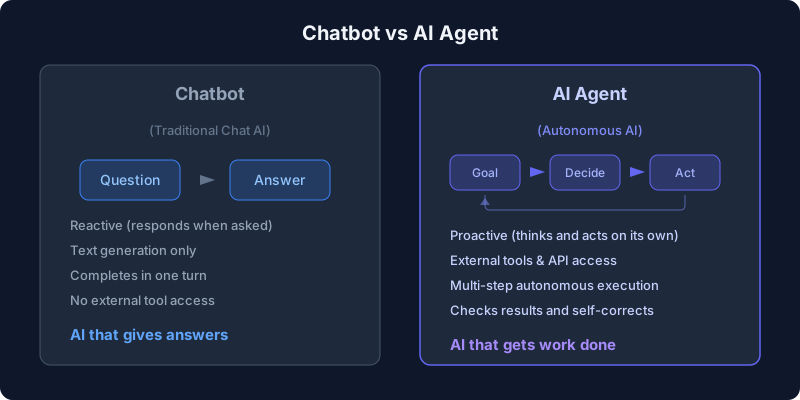
Here is a concrete comparison between traditional chatbots and AI agents.
| Aspect | Chatbot (Traditional) | AI Agent |
|---|---|---|
| Core behavior | Responds when asked (reactive) | Works toward a goal on its own (proactive) |
| Task execution | Text generation only | Can operate external tools and APIs |
| Scope | Completes in one conversation turn | Executes multi-step workflows autonomously |
| Decision-making | User directs next actions | Decides next actions itself |
| Error handling | User must point out and fix errors | Checks results and self-corrects |
| Tool integration | Basically none | File operations, web search, API calls, etc. |
A Concrete Example
Suppose you ask: "Set up our weekly team meeting for next week."
Chatbot:
- Replies with step-by-step instructions: "1. Open your calendar. 2. Check availability…"
- You still have to do everything yourself
AI Agent:
- Checks team members' calendars for availability
- Books a meeting room
- Sends calendar invites
- Drafts an agenda
- — All done automatically
Note that in 2026, services like ChatGPT have added "agent mode," meaning tools that started as chatbots are increasingly incorporating agent capabilities. Rather than thinking of chatbots and agents as separate products, it is more accurate to view them as stages in AI's evolution.
3. What AI Agents Can Do
Here are concrete examples of what AI agents can accomplish, organized by domain.
Software Development
This is the most mature use case for AI agents as of 2026.
- Autonomous code generation: Describe a feature in plain language, and the agent writes code, runs tests, and fixes bugs
- Code review and refactoring: Analyzes existing code, identifies improvements, and applies fixes
- Deployment: Handles the full pipeline from code changes through build, test, and deploy
Claude Code now generates roughly 4% of all public GitHub commits as of 2026, with projections exceeding 20% by year-end. For a detailed comparison of coding tools, see our Claude Code vs Codex article.
Business and Productivity
- Research automation: Autonomously performs market research, competitor analysis, and paper summarization. Lead research that takes 2–3 hours manually can be done in about 10 minutes
- Email and scheduling: Auto-classifies emails, drafts replies, and manages calendar coordination
- Report generation: Retrieves data from databases, analyzes, visualizes, and generates reports end to end
For more on boosting productivity with AI, see our AI business efficiency guide.
Customer Support
- Autonomous inquiry handling: Understands the question, searches databases, generates answers, and can even process returns or reschedule appointments
- Smart escalation: Identifies when an issue requires a human and routes it to the right person
Data Analysis and Decision Support
- Data pipeline construction: Collects data from multiple sources, cleans it, and runs analyses
- Anomaly detection and alerting: Monitors system logs and business metrics, detects anomalies, and suggests remedies
4. What AI Agents Cannot Do
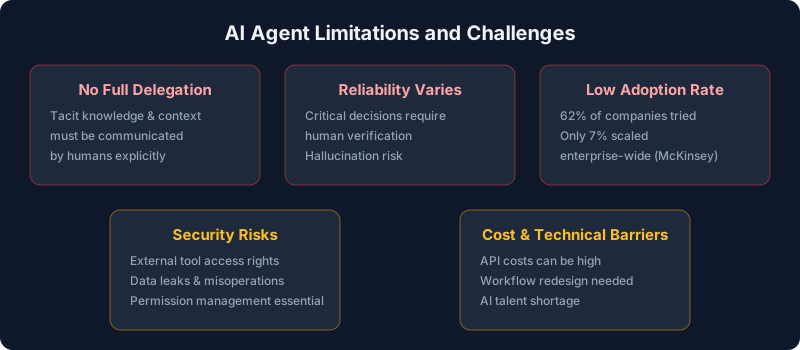
AI agents are not magic. According to a McKinsey survey (November 2025), while 62% of organizations have experimented with AI agents, only 7% have scaled them enterprise-wide. There are clear limitations.
① You Cannot Just "Throw Tasks Over the Wall"
Delegating everything to an AI agent and expecting perfect results is unrealistic. Tacit knowledge and internal context — "this manager is risk-averse," "the deal with Company B fell through" — must be explicitly communicated. No matter how advanced the model, it cannot know what you do not tell it.
Agent performance depends heavily on instruction quality. Clear goal-setting, context provision, and constraint definition are essential.
② Reliability Varies
Because AI agents operate external tools, mistakes have bigger consequences than with a chatbot. Getting a text answer wrong is one thing; sending an email to the wrong person is quite another.
The hallucination problem discussed in our AI strengths and weaknesses article becomes more serious when agents act autonomously. Critical decisions always require human verification (Human-in-the-Loop).
③ Security Risks
AI agents have execution permissions — file access, API calls, etc. — so security is a first-order concern.
- Unintended data exfiltration
- Prompt injection attacks causing misoperations
- Overly broad permissions leading to system damage
Follow the principle of least privilege: grant only the minimum permissions an agent needs.
④ Cost and Technical Barriers
AI agents make multiple API calls per workflow, so API costs can be significantly higher than traditional chat AI. Additionally, redesigning workflows and building tool integrations requires technical expertise, so the barrier to entry is not trivial.
⑤ Emotional and Ethical Judgment
This is a broader AI limitation, but it applies equally to agents. Genuinely empathizing with a frustrated customer or making ethically nuanced decisions remains beyond what any AI agent can do. See our AI strengths and weaknesses article for details.
5. Leading AI Agents in 2026
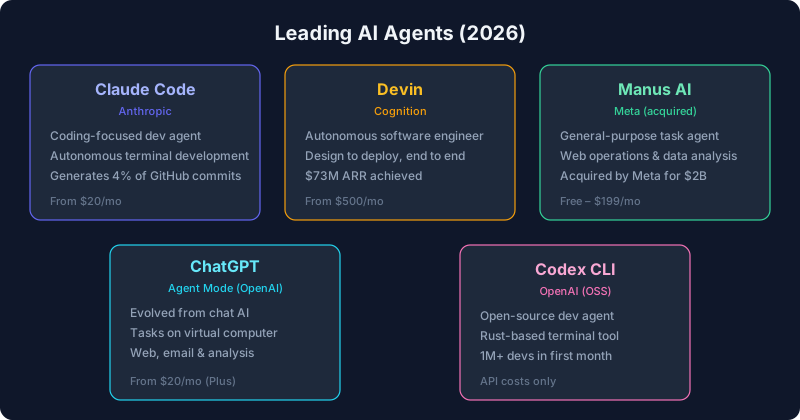
Here are the most notable AI agents in 2026. Notably, services like ChatGPT that began as chatbots have added agent capabilities, accelerating the convergence of chat AI and autonomous agents.
Coding-Focused
| Service | Provider | Key Features | Pricing |
|---|---|---|---|
| Claude Code | Anthropic | Terminal-based dev agent powered by Opus 4.6. Generates ~4% of all public GitHub commits | From $20/mo |
| Devin | Cognition | Autonomous software engineer. Handles design → implementation → deployment. $73M ARR | From $500/mo |
| Codex CLI | OpenAI (OSS) | Open-source dev agent built in Rust. 1M+ developers in its first month | API costs only |
| GitHub Copilot | GitHub / Microsoft | IDE-integrated coding assistant. The most widely adopted AI coding tool | From $10/mo |
For a detailed comparison of Claude Code and Codex, see this article.
General-Purpose
| Service | Provider | Key Features | Pricing |
|---|---|---|---|
| ChatGPT (Agent Mode) | OpenAI | Originally a chatbot, ChatGPT integrated agent capabilities in July 2025 by merging Operator + Deep Research. Executes web browsing, email, and analysis on a virtual computer | From $20/mo (Plus) |
| Manus AI | Meta (acquired) | General-purpose task agent. Web operations, data analysis, and file management. Acquired by Meta for $2 billion | Free – $199/mo |
The Connectivity Standard: MCP (Model Context Protocol)
No discussion of AI agents in 2026 is complete without MCP (Model Context Protocol). Originally introduced by Anthropic in 2024 and donated to the Linux Foundation in 2025, MCP is the standard protocol for connecting AI agents to external tools and data sources.
MCP enables different AI agents to share the same tool integration framework, fueling rapid ecosystem growth. Claude alone supports over 75 MCP connectors. For details on building with the Claude Agent SDK, see our Agent SDK guide.
6. How to Get Started
Interested in AI agents but unsure where to begin? Here is a step-by-step guide.
For Individual Users
- Try ChatGPT Plus agent mode ($20/mo): The easiest entry point to experience agents as a natural extension of chat AI
- Start with small tasks: Instead of "summarize this document," try "summarize this document and format the key points as a slide deck" — set multi-step goals
- For developers: Install Claude Code or GitHub Copilot to experience agent-assisted coding
For Teams and Enterprises
- Audit your workflows: List tasks that are repetitive, rule-based, or span multiple tools
- Start small: Pilot with one team and one workflow rather than going company-wide
- Design permissions: Define what the agent may do autonomously and what requires human approval
- Scale gradually: Expand to more workflows as results prove out
To learn AI fundamentals from scratch, check out our AI beginner's course. To test your AI knowledge, try our AI proficiency assessment.
7. Summary
| Topic | Key Takeaway |
|---|---|
| What is an AI agent? | AI that autonomously decides, acts, verifies, and completes tasks toward a goal |
| Chatbot vs. agent | "Gives answers" → "Gets work done." Agents use tools, execute multi-step workflows, and self-correct |
| What they can do | Coding, research automation, email management, data analysis, customer support, and more |
| What they cannot do | Full delegation without context, flawless judgment, emotional/ethical decisions. Security and cost remain challenges |
| Current trend | Chatbots like ChatGPT are incorporating agent features. The boundary is blurring |
| Getting started | Try ChatGPT agent mode or Claude Code with small tasks. Enterprises should pilot before scaling |
2026 marks the turning point from "the chat era" to "the agent era." As ChatGPT's addition of agent mode exemplifies, virtually every AI service is expected to incorporate agentic capabilities going forward. Start small and experience the potential of AI agents for yourself.
FAQ
What is the biggest difference between an AI agent and a chatbot?
The biggest difference is autonomy. A traditional chatbot responds to user questions with text, while an AI agent breaks goals into subtasks, operates external tools, checks results, and completes work on its own. One gives answers; the other gets work done. In 2026, services like ChatGPT have added agent capabilities, so the boundary is increasingly blurred.
Are AI agents safe? What are the risks?
AI agents have execution permissions (file access, email sending, etc.), which makes them inherently riskier than traditional chat AI. Key risks include unintended actions, prompt injection attacks, and data leaks. Always implement Human-in-the-Loop for critical actions and follow the principle of least privilege.
Can I use AI agents for free?
Some offer free tiers. Manus AI has a free plan (1,000 credits), and Codex CLI is open-source (API costs only). For full-featured access, paid plans are typical: ChatGPT Plus ($20/mo), Claude Code (from $20/mo), Devin (from $500/mo). Enterprise plans are available at higher price points.
Can I use AI agents without programming experience?
Yes. ChatGPT's agent mode and Manus AI allow you to execute tasks using natural language instructions alone, with no coding required. However, you need clear goals and well-structured instructions. The ability to articulate what you want is the key skill. For AI fundamentals, check out our AI beginner's course.
![15 Jobs Most Likely to Be Replaced by Generative AI — And How to Future-Proof Your Career [2026]](https://az-arte.com/images/articles/ai-job-loss-featured-en.svg)
![Generative AI Knowledge Cutoff Dates Compared: ChatGPT, Claude, Gemini & More [2026]](https://az-arte.com/images/articles/ai-cutoff-featured-en.svg)