Table of Contents
ChatGPT, Claude, Gemini — you hear these names every day. But do you know what technology actually powers them? It's called an LLM (Large Language Model), and understanding it is the key to using AI tools effectively.
In this guide, we'll explain what an LLM is in plain language, how it works under the hood, which models lead the market in 2026, and what limitations you need to watch out for. Everything you need to understand LLMs, all in one place.
1. What Is an LLM? — The Short Answer
A Large Language Model (LLM) is an AI system trained on massive amounts of text data that can understand and generate human-like language.
Let's break down the name:
- "Large": Trained on trillions of words from websites, books, research papers, and more
- "Language": Specialized in processing and generating text
- "Model": A mathematical system that takes input and produces output — essentially the AI's "brain"
ChatGPT runs on OpenAI's GPT series, Claude runs on Anthropic's Claude series, and Gemini runs on Google's Gemini series. In other words, an LLM is the engine that powers tools like ChatGPT and Claude.
A Simple Way to Think About It
At its core, an LLM works by predicting the next word — a surprisingly simple concept.
When you type "The weather today is," the model calculates the probability of words like "sunny," "cloudy," or "rainy" coming next, based on patterns learned from its training data. It picks the most likely continuation and repeats this process thousands of times to build complete sentences, paragraphs, and even entire essays.
2. How LLMs Work — 3 Key Steps
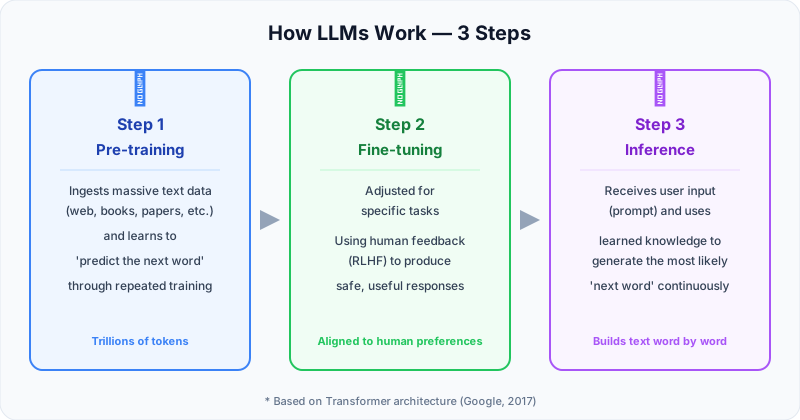
Here's how an LLM goes from raw data to generating useful responses, in three stages.
Step 1: Pre-training
The model ingests a massive corpus of text — web pages, books, academic papers, Wikipedia, and more — spanning trillions of tokens (word units). During this phase, it trains by repeatedly predicting the next word in a sequence.
For example, given "To be or not to ___," the model learns to predict "be." By doing this trillions of times, it absorbs language patterns, grammar, factual knowledge, and even reasoning abilities.
This stage requires thousands to tens of thousands of GPUs running for months or even over a year. The training cost for OpenAI's GPT-5 is estimated to have been in the hundreds of millions of dollars.
Step 2: Fine-tuning (RLHF)
After pre-training, the model can generate text but has no filter — it may produce harmful or unhelpful content. Fine-tuning uses human feedback to teach the model the difference between good and bad responses, making it safer and more useful.
This technique is called RLHF (Reinforcement Learning from Human Feedback). It's the reason ChatGPT responds politely and helpfully instead of producing raw, unfiltered text.
Step 3: Inference
When you ask a question, the LLM receives your prompt (input text) and uses its trained knowledge to generate one word at a time, always picking the most probable next word. This is why you see text appear character by character when chatting with ChatGPT or Claude.
The Foundation: Transformer Architecture
Nearly every modern LLM is built on the Transformer architecture, introduced by Google in 2017. Its breakthrough innovation is the Attention mechanism — a system that efficiently identifies which words in a sentence relate to which other words, regardless of distance.
The "T" in GPT actually stands for "Transformer."
3. Major LLMs — The 2026 Landscape
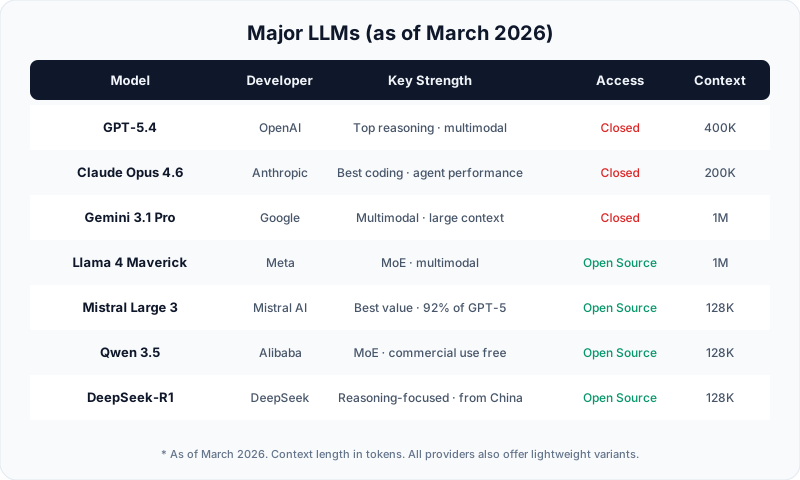
As of March 2026, the LLM world is divided into two camps: closed-source (proprietary) models and open-source models.
Closed-Source Models (Commercial APIs)
| Model | Developer | Key Strengths |
|---|---|---|
| GPT-5.4 | OpenAI | Top overall performance. 400K token context window, multimodal capabilities |
| Claude Opus 4.6 | Anthropic | Best-in-class coding and agentic performance. Strong emphasis on safety |
| Gemini 3.1 Pro | 1 million token context window. Deep integration with Google Search |
For a detailed comparison of pricing and features, see our Claude vs ChatGPT pricing comparison.
Open-Source Models
| Model | Developer | Key Strengths |
|---|---|---|
| Llama 4 Maverick | Meta | Efficient MoE architecture. Multimodal. Up to 10M tokens (Scout variant) |
| Mistral Large 3 | Mistral AI | 92% of GPT-5's performance at 15% of the cost. Best value for money |
| Qwen 3.5 | Alibaba | Apache 2.0 license for full commercial use. MoE architecture |
| DeepSeek-R1 | DeepSeek | Specialized in reasoning. Rivals commercial models in math and logic tasks |
The key advantage of open-source models is that you can run them on your own servers, keeping your data private while still leveraging LLM capabilities. The rapid rise of Chinese-developed models like DeepSeek and Qwen has dramatically expanded open-source options.
4. LLM vs Traditional AI vs Generative AI
| Aspect | Traditional AI | LLM | Generative AI |
|---|---|---|---|
| Definition | Machine learning for specific tasks | Language model trained on massive text data | Any AI that creates new content |
| Capabilities | Single tasks like spam detection or product recommendations | Versatile: writing, summarization, translation, coding, and more | Generates text, images, audio, and video |
| Flexibility | Low — each task needs a separate model | High — one model handles many different tasks | High |
| Examples | Email spam filters | ChatGPT, Claude, Gemini | LLMs + Midjourney + Sora |
To put it simply: an LLM is a text-focused type of generative AI — it's a subset of the broader generative AI category. For the full picture, check out our article on what generative AI is.
5. LLM Use Cases — What Can You Do?
LLMs are remarkably versatile, and they're already being used across countless domains.
Business Applications
- Document creation: Generate drafts of reports, emails, and proposals in seconds
- Customer support: Build automated FAQ systems and intelligent chatbots
- Data analysis: Feed in CSV files for trend analysis and automated reporting
- Software development: Use tools like Claude Code or Codex for code generation and debugging
Personal Use
- Learning: Ask an LLM to explain complex topics and deepen your understanding
- Translation and language study: Get natural translations and writing corrections
- Side income: Boost your productivity in writing, image creation, and coding (see our AI side hustle guide)
- Everyday tasks: Plan trips, get recipe ideas, organize your schedule
Specialized Fields
- Healthcare: Summarize research papers, assist with diagnosis (under expert supervision)
- Legal: Review contracts, streamline case law research
- Education: Auto-generate personalized learning materials
- Research: Accelerate literature reviews and hypothesis exploration
6. Limitations and Risks
LLMs are powerful, but they're far from perfect. Here are the limitations you need to understand before relying on them.
1. Hallucination
LLMs can generate information that sounds completely convincing but is factually wrong. According to Stanford HAI research (2024), even state-of-the-art models have error rates of 5-15%. Because LLMs predict the next word based on probability, they don't truly "know" facts.
Countermeasure: Always verify important information against primary sources.
2. Knowledge Cutoff
An LLM's knowledge stops at whatever date its training data ends. Be sure to check each model's knowledge cutoff date, and use web search integration (RAG) for anything that requires up-to-date information.
3. Bias
Biases present in the training data — including gender, racial, and cultural biases — can show up in LLM outputs. This is especially important to watch for in contexts that require fairness, such as hiring and performance evaluations.
4. Privacy and Security
When you use a cloud-based LLM, your input is sent to the service provider's servers. Always review the data policy before entering confidential or personal information. Running open-source models on your own infrastructure is one way to mitigate this risk.
5. Cost
Using cutting-edge LLMs at scale can result in API bills of thousands to tens of thousands of dollars per month. The best practice is to start small, measure ROI, and scale up gradually.
7. 2026 Trends — Where LLMs Are Headed
Multimodal Capabilities
LLMs are evolving beyond text to understand and generate images, audio, and video simultaneously. GPT-5.4 and Gemini 3.1 Pro can answer questions about images and hold real-time voice conversations.
Smaller Models, Better Efficiency
Advances in MoE (Mixture of Experts) architecture and model compression are enabling dramatic cost reductions without sacrificing performance. Mistral Large 3 delivering 92% of GPT-5's capability at just 15% of the cost is a prime example.
AI Agents
LLMs are moving beyond simple Q&A to become AI agents that can plan and execute multi-step tasks. Web research, understanding and modifying entire codebases, and orchestrating multiple tools — tasks that were impossible just a year ago are now a reality.
Reasoning Breakthroughs
Models like GPT-5.4 and Claude Opus 4.6 are achieving expert-level scores in mathematical reasoning and logical thinking. "Inference-time scaling" — spending more compute time at response generation to improve quality — is a major emerging trend.
The Open-Source Surge
Meta (Llama 4), Alibaba (Qwen 3.5), and DeepSeek (R1) are releasing open-source LLMs that rival proprietary models. This gives organizations the option to leverage LLMs while keeping their data entirely in-house.
8. Summary
| Topic | Key Takeaway |
|---|---|
| What is an LLM? | An AI model trained on massive text data to understand and generate natural language |
| How it works | Pre-training → Fine-tuning (RLHF) → Inference (predicts the next word to generate text) |
| Top models | GPT-5.4 / Claude Opus 4.6 / Gemini 3.1 Pro / Llama 4 / Mistral Large 3 / Qwen 3.5 |
| Key risks | Hallucination, knowledge cutoff, bias, privacy concerns, cost |
| 2026 trends | Multimodal, efficiency gains, AI agents, reasoning upgrades, open-source growth |
An LLM is the engine that powers tools like ChatGPT and Claude. Understanding how this engine works will make you a far more effective — and more critical — user of AI tools.
Want to build a solid AI foundation? Try our AI beginner's guide. Curious where you stand? Take our AI knowledge assessment to find out.
FAQ
Are LLMs and generative AI the same thing?
Not exactly. An LLM is a type of generative AI that specializes in text. Generative AI is the broader category, which also includes image generators (Midjourney, DALL-E), audio generators, and video generators (Sora). For a deeper dive, see our article on what generative AI is.
Do I need programming skills to use an LLM?
Not for everyday use. You can chat with tools like ChatGPT or Claude in plain English — no coding required. However, if you want to integrate an LLM into your own application via its API, you'll need some programming knowledge.
What's the difference between open-source and closed-source LLMs?
Closed-source models (GPT-5.4, Claude, etc.) are only available through APIs or web interfaces, and their inner workings are proprietary. Open-source models (Llama 4, Mistral, etc.) publish their model weights, allowing you to download and run them on your own servers. Organizations that prioritize data privacy are increasingly choosing open-source options.
Will LLM hallucinations ever be fully solved?
A complete fix is unlikely. Since LLMs work by predicting the next word based on probability, they don't inherently "know" what's true. That said, techniques like RAG (Retrieval-Augmented Generation), built-in fact-checking, and improved reasoning are steadily reducing error rates year over year. For now, the most reliable safeguard is always having a human review AI-generated output.
![15 Jobs Most Likely to Be Replaced by Generative AI — And How to Future-Proof Your Career [2026]](https://az-arte.com/images/articles/ai-job-loss-featured-en.svg)
![Generative AI Knowledge Cutoff Dates Compared: ChatGPT, Claude, Gemini & More [2026]](https://az-arte.com/images/articles/ai-cutoff-featured-en.svg)