![15 Jobs Most Likely to Be Replaced by Generative AI — And How to Future-Proof Your Career [2026]](https://az-arte.com/images/articles/ai-job-loss-featured-en.svg)
"AI is coming for my job" — it's a thought that crosses more and more people's minds these days, and it's not just idle anxiety.
According to the World Economic Forum, roughly 85 million jobs could be displaced by AI and automation by 2030. On the flip side, an estimated 97 million new roles are expected to emerge, so it's not as simple as "all jobs will vanish." But the shift is very real.
The catch is that not every occupation faces the same level of risk. In this article, we'll break down exactly which jobs are in the danger zone, which ones are safer, and what you can do right now to stay ahead of the curve.
Why AI Job Displacement Is No Longer Hypothetical
Talk of AI replacing jobs has been around for years, but between 2024 and 2026, three developments turned speculation into reality.
1. The Generative AI Explosion
Large language models like ChatGPT and Claude can now handle writing, translation, coding, and data analysis — tasks that were long considered exclusively human territory. The gap between "what AI can do" and "what your job requires" is shrinking fast.
2. Plummeting Implementation Costs
Deploying AI used to require massive upfront investment. Today, a company can plug advanced AI into its workflows through affordable APIs. This has made adoption realistic even for small and mid-sized businesses, dramatically widening the blast radius.
3. Growing Pressure to Cut Costs
With global inflation and economic uncertainty, businesses are aggressively looking to reduce headcount. The calculus has shifted: if AI can do a task, companies are pulling the trigger far more quickly than they would have a few years ago.
15 Jobs Most at Risk of AI Replacement
Based on multiple industry reports and research studies, here are the occupations facing the highest risk of being automated away.
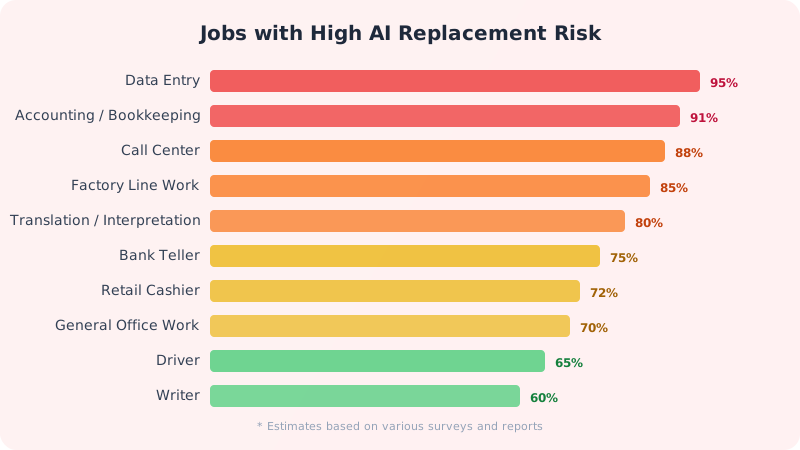
| Rank | Occupation | Risk Level | Primary Reason |
|---|---|---|---|
| 1 | Data Entry & Clerical Work | Extremely High | Routine tasks are easy to automate |
| 2 | Bookkeeping & Accounting Clerks | Extremely High | AI accounting software handles these with high accuracy |
| 3 | Call Center Agents | Very High | AI chatbots are reaching human-level performance |
| 4 | Factory Line Workers | Very High | Industrial robots combined with AI vision |
| 5 | Translators & Interpreters | Very High | Machine translation quality now rivals humans |
| 6 | Bank Tellers | High | Online banking and ATMs continue to expand |
| 7 | Retail Cashiers | High | Self-checkout and cashier-less stores are spreading |
| 8 | Administrative Assistants | High | Scheduling, drafting, and filing are being automated |
| 9 | Truck & Taxi Drivers | Medium–High | Autonomous driving technology is advancing rapidly |
| 10 | Content Writers & Reporters | Medium–High | Generative AI can produce articles at scale |
| 11 | Real Estate Agents | Moderate | AI property matching and virtual tours |
| 12 | Insurance Sales Agents | Moderate | AI-driven plan optimization and direct sales |
| 13 | Pharmacists (Dispensing) | Moderate | Robotic dispensing and AI prescription checks |
| 14 | Tax Preparers & Auditors | Moderate | Automated tax processing and AI auditing |
| 15 | Programmers (Basic Coding) | Moderate | AI coding assistants are increasingly capable |
One striking takeaway: white-collar jobs are well represented on this list. Previous waves of automation primarily targeted manual labor, but generative AI has brought knowledge work squarely into the crosshairs.
What Makes a Job Harder for AI to Replace
So what do AI-resistant jobs have in common? They tend to share four key traits.
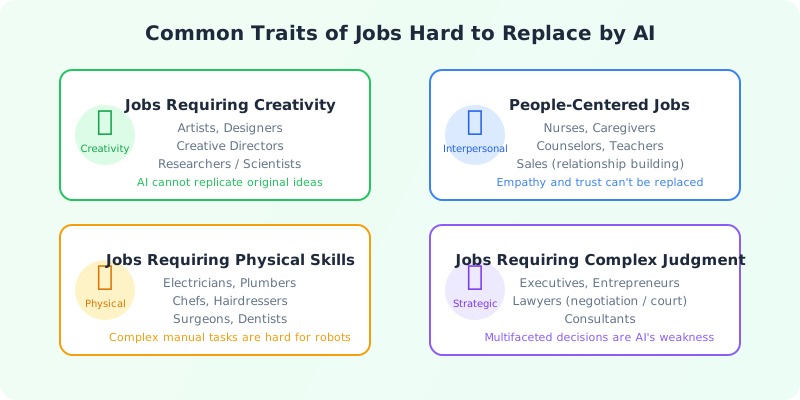
Jobs That Demand Genuine Creativity
AI excels at remixing existing patterns, but it struggles to produce truly original ideas from scratch. Artists, researchers, and creative directors who bring a unique perspective and vision to their work are far harder to replace.
There's a caveat, though: if your creative output is the kind that people would say "AI-generated is good enough" for, that's a warning sign. What matters is whether you bring a point of view that AI simply cannot replicate.
Jobs Built on Human Relationships
Nurses, caregivers, counselors, and teachers — roles where trust, empathy, and personal connection are essential — remain firmly in human territory. An AI chatbot might answer a patient's questions, but it can't hold someone's hand to ease their fears or mentor a student through a personal breakthrough.
Jobs Requiring Complex Physical Skills
Electricians, plumbers, surgeons, and hairstylists all rely on a combination of manual dexterity and real-time judgment that robots still can't match. Robotics is advancing, but replicating the human hand's versatility in unpredictable environments remains a formidable challenge.
Jobs Involving High-Level Strategic Decisions
CEOs, management consultants, and trial lawyers — professionals who synthesize multiple factors, persuade stakeholders, and bear ultimate responsibility — aren't easily replaced. AI can support decision-making with data analysis, but the final call and the accountability that comes with it remain fundamentally human.
It's Already Happening: Real-World Examples
If you're thinking "this is all someday stuff," think again. The shift is well underway.
Major Companies Already Making the Switch
| Company / Industry | What Happened | Impact |
|---|---|---|
| IBM Hiring Freeze | Announced plans to replace roughly 7,800 back-office roles with AI | Significant reduction in administrative staff |
| Klarna (Fintech) | AI chatbot now handles the workload of 700 customer support agents | Major downsizing of the support team |
| Major Banks | Large banks have launched AI-driven restructuring affecting thousands of positions | Cuts to teller and back-office roles |
| News Agencies & Media | Sports recaps and earnings reports are now auto-generated by AI | Fewer reporters needed for formulaic articles |
These are just the high-profile cases. Behind the scenes, countless companies are quietly integrating AI to streamline operations. By the time it becomes visible at your own workplace, the transition may already be well advanced.
5 Strategies to Thrive in the Age of AI
If the list above made you uneasy, that's understandable. But the goal isn't to panic — it's to prepare. Here are five concrete strategies to keep you ahead.
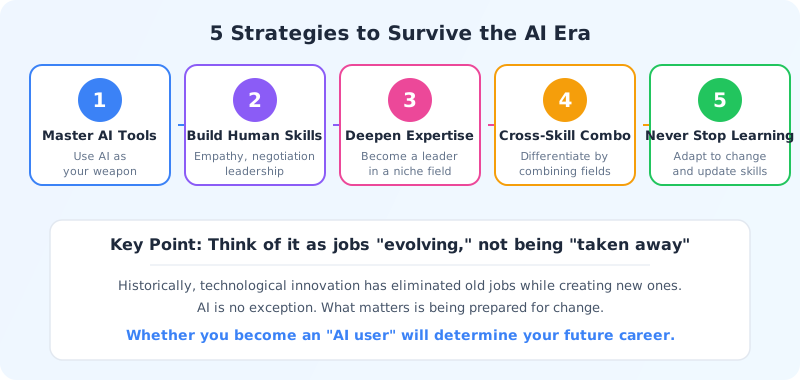
Strategy 1: Become an AI Power User
This is the single most impactful move you can make. The difference between someone whose job gets replaced by AI and someone who multiplies their output tenfold is simple: the ability to use AI tools effectively.
Start using tools like ChatGPT and Claude in your daily work. Experiment with how they can speed up your tasks. In the job market, "proficient with AI tools" is rapidly becoming a must-have on resumes. If you want to learn more about how to use Claude effectively, check out our guide to Claude's three tabs.
Strategy 2: Develop Your Human Skills
Empathy, negotiation, leadership, team building — these distinctly human abilities are becoming more valuable, not less, in an AI-powered world.
AI might replicate technical skills, but it can't build trust with a client over lunch or rally a demoralized team. Investing in interpersonal skills offers some of the highest returns of any career investment you can make.
Strategy 3: Go Deep in a Specialty
AI is great at being a generalist — decent at a lot of things. That means specialists with deep domain expertise are harder to replace.
Rather than being "pretty good at everything," aim to be the go-to person in a specific field. The more niche your expertise, the less training data AI has to work with, and the more your real-world experience and intuition matter.
Strategy 4: Stack Skills Across Disciplines
A single skill may be vulnerable on its own, but combining expertise from different fields creates a profile that AI can't easily replicate.
Think "marketing plus data science," "design plus programming," or "healthcare plus AI implementation." By multiplying skills from different domains, you carve out a unique position that's genuinely hard to automate.
Strategy 5: Commit to Lifelong Learning
AI technology evolves at a breakneck pace. What was cutting-edge last year may be obsolete today. The most important skill isn't any single piece of knowledge — it's the ability to keep learning.
Online courses, books, professional communities — the resources are everywhere. Instead of fearing change, build the habit of adapting to it.
Conclusion: Prepare, Don't Panic
The transformation AI is bringing to the job market is inevitable. But history shows that every major disruption — from the Industrial Revolution to the rise of the internet — eliminated some jobs while creating entirely new ones.
Here's what matters most:
- Honestly assess your risk: The more routine and repetitive your work, the higher the danger
- Treat AI as a tool, not a threat: Demand for people who can harness AI is skyrocketing
- Start today: Waiting until the wave hits is too late — the earlier you prepare, the better your position
Instead of dreading a future where AI takes your job, start exploring what it looks like to work alongside AI. That first step? There's no better time to take it than right now.
Frequently Asked Questions
Which jobs are most at risk of being replaced by AI?
The impact is already being felt in some industries. The WEF predicts that around 85 million jobs will be affected by 2030, though the timeline varies by occupation and the pace of AI adoption. Jobs with a high proportion of routine tasks tend to be affected earliest.
Will AI completely replace human jobs?
Simple coding tasks do face replacement risk, but engineers with complex skills — system design, architecture decisions, and understanding client requirements — are actually in higher demand. Engineers who can wield AI as a tool will be increasingly valued.
What skills should I develop to survive the AI era?
The most effective approach is to become someone who can harness AI rather than be replaced by it. On top of that, developing distinctly human skills — empathy, creativity, leadership — and deepening your expertise in a specific field are essential. See the "5 Strategies to Survive the AI Era" section in this article for more details.
![Generative AI Knowledge Cutoff Dates Compared: ChatGPT, Claude, Gemini & More [2026]](https://az-arte.com/images/articles/ai-cutoff-featured-en.svg)
![Which Frameworks Are Most Generative AI-Friendly? A Complete Compatibility Guide [2026]](https://az-arte.com/images/articles/ai-friendly-frameworks-en.svg)