![Which Frameworks Are Most Generative AI-Friendly? A Complete Compatibility Guide [2026]](https://az-arte.com/images/articles/ai-friendly-frameworks-en.svg)
In 2026, writing code with Cursor and GitHub Copilot has become the norm. Data suggests that over 85% of developers now use AI coding tools on a daily basis. Yet many have experienced the frustration of AI-generated code that simply doesn't work.
The truth is, the quality of AI-generated code varies dramatically depending on which framework you choose. Frameworks with abundant training data produce more accurate code, and frameworks with clear conventions make it easier for AI to find the "right answer." In this article, we'll compare the AI compatibility of major frameworks and introduce the ideal 2026 development stack.
Table of Contents
- 1. Why AI Performs Differently Across Frameworks
- 2. Frontend: React / Next.js / Vue / Svelte
- 3. Backend: Django / Laravel / Rails / Express
- 4. Mobile: Flutter / React Native
- 5. Framework AI Compatibility Scorecard
- 6. What AI-Friendly Frameworks Have in Common
- 7. The Recommended 2026 AI Dev Stack
- 8. Conclusion
- FAQ
1. Why AI Performs Differently Across Frameworks
AI coding tools may all look the same on the surface, but the quality of generated code actually varies significantly from framework to framework. There are three main reasons for this.
Differences in Training Data Volume
AI models are trained on massive amounts of code data from GitHub repositories, Stack Overflow questions, and other sources. Naturally, frameworks with more representation in the training data produce more accurate code. Python and JavaScript/TypeScript have overwhelmingly large data volumes, giving frameworks built on these languages a clear AI compatibility advantage.
Convention Clarity
There's a big difference between a framework where "there are 10 ways to do the same thing" and one where "there's only one right answer." Frameworks with a "Convention over Configuration" philosophy, like Rails and Django, make it much easier for AI to generate correct code without second-guessing.
Documentation Quality
Frameworks with thorough official documentation and clearly stated best practices allow AI to learn more efficiently. React's official docs are exceptionally comprehensive, which directly contributes to the high quality of AI-generated React code.
2. Frontend: React / Next.js / Vue / Svelte
React / Next.js -- Top-Tier AI Compatibility
React has the most abundant training data of any UI library. It leads in GitHub repository count, npm downloads, and Stack Overflow questions, giving AI an overwhelming number of code examples to draw from.
Next.js in particular has become the de facto standard for "vibe coding" (the style of development where you convey the general idea to AI and let it write the code) in 2026. AI handles App Router, Server Components, and Server Actions well, making it easy to delegate everything from project scaffolding to deployment.
Vue / Nuxt -- Solid but Less Data
Vue has adequate training data, but falls short of React in volume. The clear structure of Single File Components (.vue) is easy for AI to understand. However, with the shift to Nuxt 3 and Composition API + TypeScript, AI sometimes generates outdated Options API code.
Svelte / SvelteKit -- Growing Potential
Svelte offers a great developer experience with minimal boilerplate, but its training data volume lags significantly behind React and Vue. AI-generated Svelte code usually works, but sometimes deviates from best practices. It's a framework to watch for the future.
3. Backend: Django / Laravel / Rails / Express
Django -- Python Power Meets Strong Conventions
Django is built on Python, the language AI understands most deeply. Its clear MVT (Model-View-Template) structure, powerful ORM, and auto-generated admin panel are all well-defined conventions that help AI produce correct code. Seamless integration with data science and ML libraries makes it an ideal backend for AI-powered applications.
Laravel -- Great Conventions, but Watch for Context Fragmentation
Laravel dominates the PHP framework market and has abundant training data. Its Eloquent ORM, Blade templates, and Artisan commands provide clear conventions that AI handles well.
However, there's a caveat. Since Laravel separates backend (PHP) from frontend (JavaScript), AI context can get fragmented. For instance, Alpine.js or Livewire code within Blade templates mixes PHP and JS, which can confuse AI. You can mitigate this by strategically choosing between Claude's Chat, Cowork, and Code modes.
Rails -- The Original Convention over Configuration
Ruby on Rails is the framework that most strongly embodies the "Convention over Configuration" philosophy. File placement, naming conventions, and database migration methods all follow "the Rails Way." This is extremely helpful for AI -- when there's only one right answer, it can generate code with confidence.
On the other hand, Ruby's training data volume is smaller than Python or JavaScript. As a dynamically-typed language, errors in AI-generated code aren't caught at compile time and may only surface at runtime.
Express / Fastify -- The Too-Much-Freedom Trap
Node.js Express has an enormous amount of training data, but its excessive flexibility makes it hard for AI to decide "how to write things." There are too many patterns for routing, middleware, and error handling. Fastify has clearer conventions, but less training data than Express.
4. Mobile: Flutter / React Native
React Native -- Leveraging React Knowledge
React Native benefits from the React ecosystem, and AI code generation quality is relatively high. However, when dealing with native module integration or platform-specific issues, AI response quality tends to drop.
Flutter -- Growing but Data-Limited
Flutter uses the Dart language, which means its total training data volume is smaller than React Native's. That said, its widget-based declarative UI is a structure AI can understand well, and standard UI generation is reliable. Google's strong documentation efforts are also a plus.
5. Framework AI Compatibility Scorecard
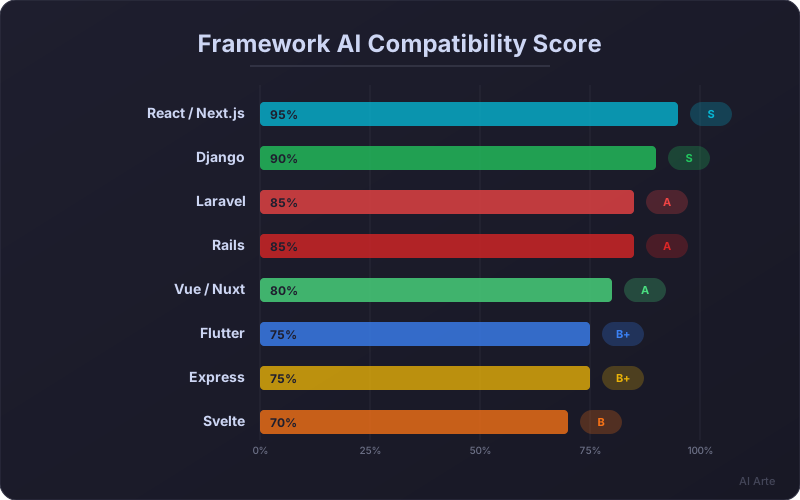
Based on the analysis above, here's a scored comparison of each framework's AI compatibility.
| Framework | Language | Training Data | Convention Clarity | Type Safety | Overall AI Score |
|---|---|---|---|---|---|
| React / Next.js | TypeScript | ★★★★★ | ★★★★ | ★★★★★ | S |
| Django | Python | ★★★★★ | ★★★★★ | ★★★ | S |
| Laravel | PHP | ★★★★ | ★★★★★ | ★★ | A |
| Rails | Ruby | ★★★ | ★★★★★ | ★★ | A |
| Vue / Nuxt | TypeScript | ★★★★ | ★★★★ | ★★★★ | A |
| Express | JavaScript | ★★★★★ | ★★ | ★★★ | B+ |
| React Native | TypeScript | ★★★★ | ★★★ | ★★★★ | A |
| Flutter | Dart | ★★★ | ★★★★ | ★★★★★ | B+ |
| Svelte | TypeScript | ★★ | ★★★★ | ★★★★ | B |
React/Next.js and Django claim the S rank. Beyond abundant training data, React/Next.js excels in type safety through TypeScript, while Django shines with its convention clarity. Laravel, Rails, and Vue/Nuxt follow closely at A rank.
6. What AI-Friendly Frameworks Have in Common
Let's identify the shared characteristics of top-scoring frameworks.
Convention-First Design Philosophy
The clearer a framework's rules about "how things should be written," the easier it is for AI to generate correct code. Guidelines like Django's "Fat Models, Thin Views" or Rails' "Convention over Configuration" keep AI from second-guessing. Conversely, frameworks like Express that say "write however you want" lead to inconsistent AI output.
Rich Documentation and Community
Frameworks that go beyond good official docs to offer abundant tutorials, blog posts, and video content provide AI with higher-quality training data. React leads the pack in this regard.
Type Safety
Frameworks using statically-typed languages like TypeScript or Dart can catch errors in AI-generated code at compile time. This is an easily overlooked but critically important factor. Python and Ruby are dynamically typed, meaning AI mistakes may go unnoticed until runtime. Python's type hints can help mitigate this.
To get the most out of AI code generation, it's also important to know when each AI model's knowledge was last updated. If the AI's knowledge hasn't caught up with a framework update, it may generate code using outdated APIs.
7. The Recommended 2026 AI Dev Stack
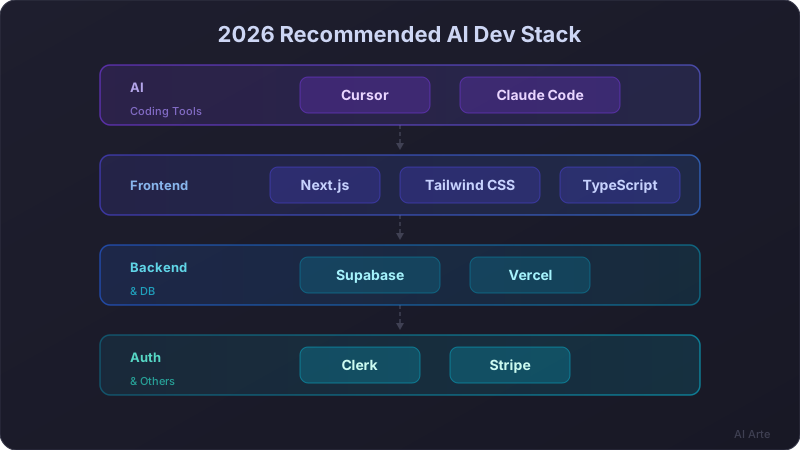
If you want to build apps as fast as possible with AI in 2026, here's the recommended stack.
| Layer | Recommended Tech | Why |
|---|---|---|
| Frontend | Next.js + TypeScript | Most training data available; the standard for vibe coding |
| Styling | Tailwind CSS | Class-based approach is easy for AI to generate |
| Backend / DB | Supabase | PostgreSQL + auth + storage in one package |
| Authentication | Clerk | Implementable in a few lines; AI generates accurately |
| Deployment | Vercel | Full Next.js integration with zero-config deploys |
| AI Editor | Cursor | Best compatibility with Claude models |
The strength of this stack is that every layer uses technology that's "easy for AI to generate." Next.js + Tailwind CSS is the combination with the most AI training data, and Supabase and Clerk abstract away complex backend logic with simple APIs.
For AI editors, Cursor is currently the best choice. Its agent capabilities, powered by Claude Agent SDK, enable smooth changes across multiple files.
Of course, this is the optimal selection when prioritizing "AI compatibility" above all else. Depending on your team's skill set and project requirements, other combinations like Django + React or Laravel + Vue may be more appropriate. The key is to make technology decisions with an understanding of what AI does best.
8. Conclusion
When enlisting AI for app development, framework choice matters more than you might think. Here are the key takeaways:
- Training data volume: React/Next.js, Django, and Express are especially well-represented, making AI-generated code more accurate
- Convention clarity: Frameworks like Django, Rails, and Laravel with "one right way" are ideal for AI
- Type safety: TypeScript and Dart let you catch AI mistakes at compile time
- The 2026 speed stack: Next.js + Tailwind + Supabase + Vercel is the go-to combination
AI coding tools continue to evolve daily, but the principle of "choosing AI-friendly frameworks" isn't going away anytime soon. Pick the right framework for your project, and let AI work at its full potential.
FAQ
Q. Which framework has the best AI coding tool compatibility?
Overall, React/Next.js (TypeScript) and Django offer the best compatibility. React has an overwhelming amount of training data among UI libraries, while Django benefits from Python's rich training data and clear conventions. That said, the "best" choice depends on your project requirements and team skills.
Q. Static typing vs. dynamic typing -- which is better for AI?
Static typing (TypeScript, Dart, Go, etc.) has a clear advantage when working with AI. Type errors in AI-generated code are caught immediately at compile time, reducing the risk of bugs reaching production. With dynamic typing (Python, Ruby, PHP), errors may not surface until runtime. That said, dynamically-typed languages like Python can introduce type checking through type hints.
Q. What is "vibe coding"?
"Vibe coding" is a development style where you describe the general idea of what you want to build in natural language and let AI generate the code. Instead of giving detailed implementation instructions, you convey the direction and "vibe" of what you're after. The combination of Next.js + Vercel + Supabase has established itself as the go-to stack for vibe coding in 2026.
Q. Cursor or GitHub Copilot -- which should I choose?
It depends on your use case. Cursor has deep integration with Claude models and excels at agent-like tasks such as multi-file edits and whole-project understanding. GitHub Copilot offers seamless VS Code integration and the flexibility to choose from multiple models (GPT, Claude, Gemini, etc.). We recommend trying the free plans of both to see which fits your workflow.
![15 Jobs Most Likely to Be Replaced by Generative AI — And How to Future-Proof Your Career [2026]](https://az-arte.com/images/articles/ai-job-loss-featured-en.svg)
![20 Best Generative AI Tools for Game Development: Art, Music, Coding & More [2026]](https://az-arte.com/images/articles/ai-gamedev-tools-featured-en.svg)