![Generative AI Knowledge Cutoff Dates Compared: ChatGPT, Claude, Gemini & More [2026]](https://az-arte.com/images/articles/ai-cutoff-featured-en.svg)
Table of Contents
- 1. What Is a Knowledge Cutoff Date?
- 2. Cutoff Date Comparison Table
- 3. ChatGPT (OpenAI)
- 4. Claude (Anthropic)
- 5. Gemini (Google)
- 6. Grok (xAI)
- 7. Microsoft Copilot / GitHub Copilot
- 8. Perplexity AI
- 9. Open-Source Models (Llama & Mistral)
- 10. How Web Search Changes the Game
- 11. Best AI Tool for Each Use Case
- FAQ
1. What Is a Knowledge Cutoff Date?
Have you ever asked an AI about recent news only to get a reply like "my training data only goes up to [date]"? That date is the knowledge cutoff.
AI models are built by training on massive text datasets, but those datasets have a hard deadline. For any events or information published after the cutoff, the model on its own cannot give an accurate answer.
That said, many modern AI tools now include web search, which lets them fetch up-to-date information beyond the cutoff. The key is understanding the difference between what the model "knows" natively and what it can look up in real time.
2. Cutoff Date Comparison Table
Here is a side-by-side look at cutoff dates for the major AI tools as of March 2026.
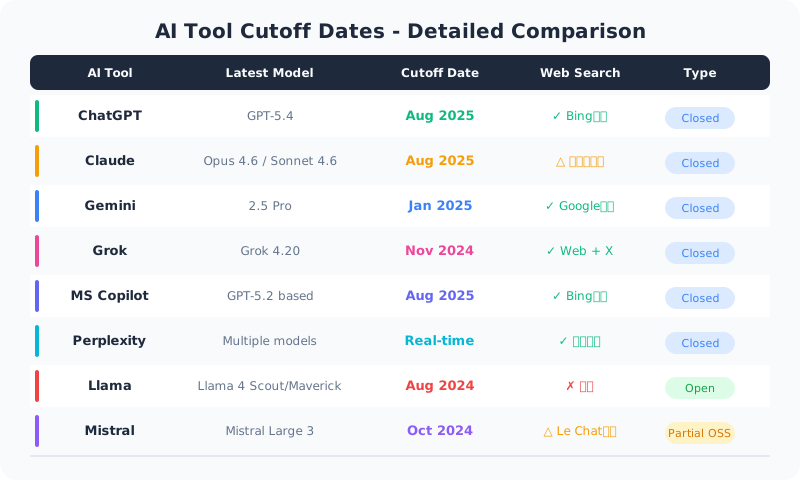
| AI Tool | Latest Model | Cutoff Date | Web Search |
|---|---|---|---|
| ChatGPT | GPT-5.4 | August 2025 | ✓ Yes (Bing) |
| Claude | Opus 4.6 / Sonnet 4.6 | August 2025 (reliable knowledge) | △ Via tools |
| Gemini | 2.5 Pro | January 2025 | ✓ Yes (Google) |
| Grok | Grok 4.20 | November 2024 | ✓ Yes (Web + X) |
| MS Copilot | GPT-5.2 based | August 2025 | ✓ Yes (Bing) |
| Perplexity | Multiple models | Real-time | ✓ Always-on search |
| Llama | Llama 4 Scout/Maverick | August 2024 | ✗ No |
| Mistral | Mistral Large 3 | October 2024 | △ Via Le Chat |
ChatGPT and Claude lead with August 2025 cutoffs, followed by Gemini at January 2025. Open-source models like Llama and Mistral have older cutoffs but offer the freedom to self-host and customize.
3. ChatGPT (OpenAI)
OpenAI's ChatGPT currently runs on the flagship GPT-5.4 model, released in March 2026. Its knowledge cutoff is August 31, 2025.
Here is a quick rundown of cutoff dates across GPT model generations:
| Model | Cutoff Date | Notes |
|---|---|---|
| GPT-5.4 | August 2025 | Latest flagship |
| GPT-5.2 | August 2025 | Instant / Thinking / Pro variants |
| GPT-5 | September 2024 | 400K context window |
| GPT-4o | June 2024 | Deprecated February 2026 |
All ChatGPT models have access to Bing-powered web search, so they can retrieve information past the cutoff. Search results include source links, making it easy to verify claims.
4. Claude (Anthropic)
Anthropic's Claude takes a unique approach with a two-tier cutoff system:
- Reliable knowledge cutoff — Information up to this date is answered with high confidence.
- Training data cutoff — Data is included but accuracy may be slightly lower.
| Model | Reliable Knowledge | Training Data | Notes |
|---|---|---|---|
| Opus 4.6 | August 2025 | August 2025 | Top-tier performance |
| Sonnet 4.6 | August 2025 | January 2026 | Best cost-performance ratio |
| Haiku 4.5 | February 2025 | July 2025 | Fast and affordable |
Claude does not have built-in web search, but it can access external information through the Agent SDK and tool integrations. In Claude Code, the WebSearch tool is available for real-time lookups.
5. Gemini (Google)
Google's Gemini stands out thanks to its deep integration with Google Search. The flagship Gemini 2.5 Pro has a knowledge cutoff of January 31, 2025, but Google Search fills in the gaps with real-time data.
Worth noting: Google plans to deprecate many Gemini 2.0/2.5 models by June 2026. The transition to next-generation models (Gemini 3.x) is underway, with Gemini 3.1 Flash-Lite already available.
Gemini's biggest advantage is its tight integration with the Google ecosystem — Gmail, Google Docs, Sheets, and more — making it especially useful for business workflows.
6. Grok (xAI)
Elon Musk's xAI built Grok with real-time access to X (formerly Twitter) data. Its base knowledge cutoff is November 2024, but it compensates with web search and live X post data.
The latest Grok 4.20 entered beta in February 2026 and launched its API in March. It uses a 3-trillion-parameter Mixture of Experts (MoE) architecture and is known for its distinctive, often humorous response style.
7. Microsoft Copilot / GitHub Copilot
Microsoft Copilot runs on GPT-5.2 under the hood, giving it an August 2025 cutoff. Because it always supplements responses with Bing search, the cutoff rarely matters in practice.
GitHub Copilot focuses on code but has evolved into a multi-model platform. GPT-5.3-Codex (LTS) is the default, but you can choose from 12+ models including Claude Sonnet/Opus, Gemini 2.5 Pro, and Grok Code Fast.
8. Perplexity AI
Perplexity AI takes a fundamentally different approach. Every query triggers a real-time web search, pulling from multiple sources to build an answer. This means the concept of a knowledge cutoff essentially does not apply.
On the backend, users can choose from GPT-5.4, Claude 4.6, Gemini 3.1 Pro, and other models. In February 2026, Perplexity added a "Model Council" feature that lets you compare outputs across models. Processing around 780 million queries per month, it leads the pack for research-oriented tasks.
9. Open-Source Models (Llama & Mistral)
Open-source (open-weight) models can be freely downloaded and run locally — their biggest advantage. However, they do not include web search out of the box.
Meta Llama 4
Llama 4 comes in two variants: Scout (109B parameters) and Maverick (400B parameters). The knowledge cutoff is August 2024, which is older than proprietary alternatives. However, Scout offers a 10-million-token context window, making it exceptionally strong for ultra-long documents.
Mistral Large 3
France-based Mistral offers a 675B-parameter MoE model with a October 2024 cutoff. Web search is available through their Le Chat chatbot. Mistral has been less forthcoming about publishing exact cutoff dates, which leaves room for improvement on the transparency front.
10. How Web Search Changes the Game
Whether a knowledge cutoff matters in practice depends heavily on whether the tool supports web search.
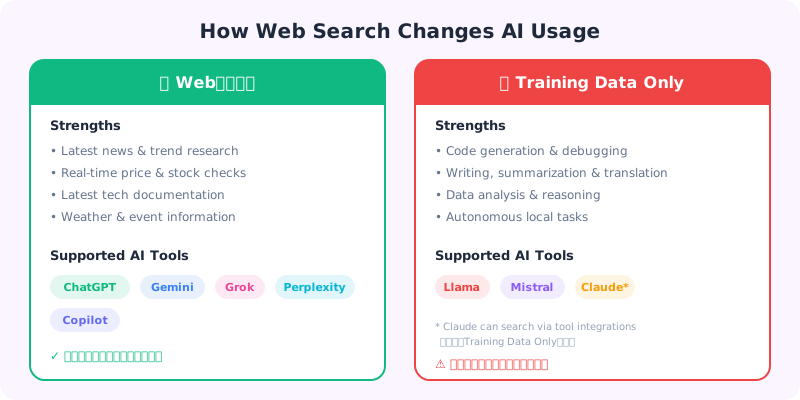
Tools with web search can fetch information well past their cutoff dates. That said, the quality of search results varies by tool. In practice, Perplexity excels with thorough source citations, and ChatGPT's Bing integration is consistently reliable.
On the other hand, tools like Claude that excel in raw reasoning shine in tasks that don't require the latest information — code generation, data analysis, and complex problem solving. An older cutoff doesn't make a tool inferior; choosing the right tool for the task is what matters.
11. Best AI Tool for Each Use Case
| Use Case | Recommended Tool | Why |
|---|---|---|
| Breaking news research | Perplexity / ChatGPT | Real-time search with source citations |
| Coding | Claude / GitHub Copilot | Strong reasoning and IDE integration |
| Business documents | Gemini / ChatGPT | Google/MS ecosystem integration |
| Social media trends | Grok | Direct access to X data |
| Local AI deployment | Llama / Mistral | Privacy and full customization |
There is no single "best AI." If you need the latest information, go with Perplexity or ChatGPT. For deep reasoning, choose Claude. For Google Workspace integration, pick Gemini. For privacy, run Llama locally. Each tool has a distinct sweet spot.
FAQ
Q. What exactly is a knowledge cutoff date?
It is the last date included in the data used to train an AI model. The model cannot accurately answer questions about events or information published after this date unless it has access to web search. For example, a model with an August 2025 cutoff cannot answer questions about events in January 2026 from its training data alone.
Q. Does web search make the cutoff date irrelevant?
Not entirely. Web search is a supplement, not a replacement. The model's base knowledge influences how it interprets search results. Also, some information simply isn't searchable — deleted pages, paywalled content, and so on. A more recent base cutoff generally means better comprehension of search results.
Q. Can I add web search to open-source models?
Yes. By combining models like Llama or Mistral with RAG (Retrieval-Augmented Generation), you can enable web search or connect to internal databases. Frameworks like LangChain and LlamaIndex make this relatively straightforward to implement.
Q. Will cutoff dates matter less over time?
All major AI companies are working to push cutoff dates as close to the present as possible. At the same time, web search and tool integrations are getting better fast. In the future, cutoff dates may become a non-issue. For now, though, it still pays to understand both a model's base knowledge and its real-time capabilities so you can pick the right tool for the job.
![15 Jobs Most Likely to Be Replaced by Generative AI — And How to Future-Proof Your Career [2026]](https://az-arte.com/images/articles/ai-job-loss-featured-en.svg)
![Which Frameworks Are Most Generative AI-Friendly? A Complete Compatibility Guide [2026]](https://az-arte.com/images/articles/ai-friendly-frameworks-en.svg)