Table of Contents
"ChatGPT and Claude are amazing" — you hear it everywhere. But have you ever wondered:
- "What can AI actually do?"
- "Is it really capable of everything?"
- "How far can I rely on it at work?"
The short answer: AI is remarkably good at pattern-based tasks, but still falls short when human judgment and creativity are needed.
In this article, we break down AI's capabilities into 6 strengths and 6 limitations with concrete examples, based on the state of AI as of March 2026. If you're new to the topic, our guide to generative AI provides helpful background.
1. Why Understanding AI's Limits Matters
People tend to fall into one of two camps when it comes to AI:
| Type | Mindset | Problem |
|---|---|---|
| Overestimation | "AI can automate everything" | Disappointment when results don't match expectations → adoption stalls |
| Underestimation | "AI isn't good enough to use yet" | Competitors gain productivity advantages → falling behind |
According to Gartner (2025), roughly 40% of AI adoption projects were scaled back or cancelled due to gaps between expectations and reality. On the flip side, companies that succeeded understood what AI is — and isn't — good at, and deployed it selectively for the right tasks.
Getting AI right starts with understanding its strengths and limits.
2. What AI Can Do — 6 Strengths
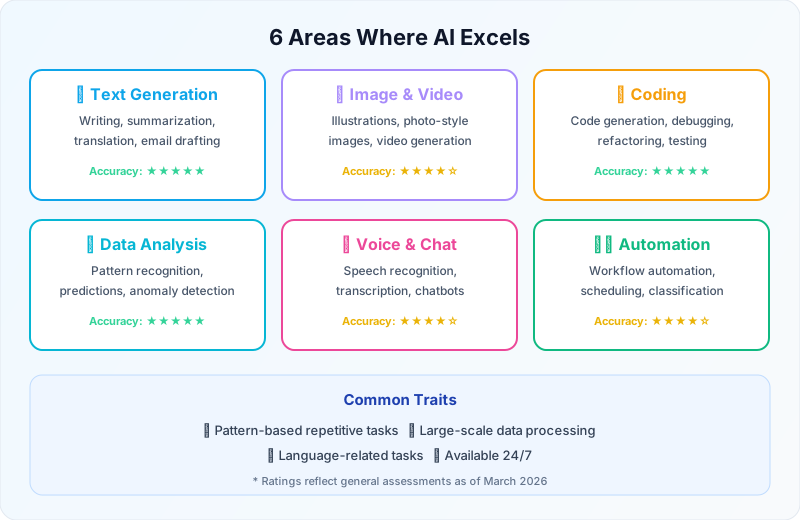
Here are the six areas where today's AI — especially generative AI tools like ChatGPT, Claude, and Gemini — truly shines.
① Text Generation, Summarization, and Translation
This is AI's strongest suit. Drafting documents, summarizing content, translating languages, composing emails, and generating reports — AI handles language tasks at a level that rivals (and sometimes surpasses) humans.
Real-world examples:
- Condensing a long meeting transcript into a 3-line summary
- Translating business emails between languages naturally
- Drafting SEO-optimized article outlines and first drafts
- Creating press release templates in minutes
Research from MIT Sloan (2024) found that AI writing assistants reduced document creation time by an average of 40%.
② Image and Video Generation
AI image generators like Midjourney, DALL-E, and Stable Diffusion create high-quality visuals from text prompts alone. Video generation tools like Sora are evolving rapidly.
Real-world examples:
- Creating blog thumbnails in seconds
- Generating presentation illustrations on demand
- Producing UI design mockups for prototyping
③ Coding Assistance
Tools like Claude Code and GitHub Copilot handle code generation, bug fixing, refactoring, and test creation with impressive accuracy. As discussed in our Claude Code vs Codex comparison, GitHub's own research shows developer productivity improvements of over 55%.
④ Data Analysis and Prediction
Finding patterns in large datasets, making predictions, and generating recommendations is one of AI's core competencies.
- Sales forecasting based on historical data
- Customer churn prediction
- Anomaly detection (fraud, equipment failures)
- Automated CSV and spreadsheet analysis
⑤ Voice Recognition and Conversation
Speech-to-text accuracy now exceeds 95%, making automated meeting transcription production-ready. AI chatbots for customer support have shown dramatic results — some companies have reduced support costs by 97%.
⑥ Workflow Automation
Routine workflows — email sorting, data entry, scheduling — can now be automated with AI. The rise of AI agents means even multi-step tasks can be executed autonomously.
3. What AI Cannot Do — 6 Limitations
Despite its impressive capabilities, AI has clear limits. Ignoring these leads to unrealistic expectations and costly failures.
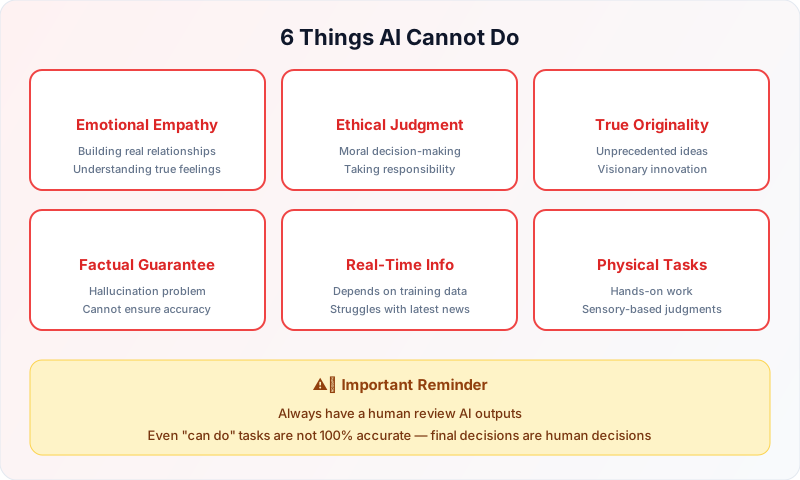
① Emotional Understanding and Empathy
AI can say "I'm sorry to hear that," but it doesn't actually understand emotions. It predicts appropriate responses from text patterns. Counseling, negotiation, and team management — work that requires genuine human connection — remains firmly in human territory.
② Ethical Judgment and Accountability
"Is this decision morally right?" "Who takes responsibility?" — AI cannot make these calls. Decisions with legal or ethical weight must remain with humans.
③ True Originality from Scratch
AI recombines existing data to generate novel content, but it cannot produce ideas nobody has ever had before. Breakthrough visions like Steve Jobs' iPhone concept remain a uniquely human domain.
That said, AI is an excellent brainstorming partner for combining existing ideas in new ways. It can help you find the seeds of originality.
④ Factual Accuracy Guarantee (Hallucinations)
This is AI's most critical limitation. AI sometimes generates plausible-sounding but factually incorrect information with full confidence — a phenomenon known as "hallucination."
Research from Stanford HAI (2024) reports that even the latest LLMs have factual error rates of 5–15%. While that may seem low, in fields like healthcare, law, and finance, it can be catastrophic.
Mitigation: Always fact-check AI outputs. Cross-reference important claims with primary sources.
⑤ Real-Time Information
Standard AI models (without web search) only know what was in their training data. They can't answer "What's today's stock price?" or "What happened yesterday?" Integration with web search and RAG (Retrieval Augmented Generation) is improving this, but knowledge cutoff dates still matter.
⑥ Physical World Tasks
AI can "think" but cannot "use its hands." Manufacturing, caregiving, cooking, construction — tasks that require physical action need robotics integration. While robotics is advancing, human-level dexterity remains distant.
4. The Gray Zone — Can Do, But Proceed with Caution
Between "can do" and "cannot do" lies a gray zone where AI works but shouldn't be trusted blindly.
| Domain | What AI Does | Risk | Recommended Approach |
|---|---|---|---|
| Legal Advice | Searches relevant laws, explains statutes | Risk of incorrect interpretation | Use as preliminary research, always consult a lawyer |
| Medical Info | Suggests possible conditions from symptoms | Potential misdiagnosis | Reference only — never a substitute for a doctor |
| Financial Analysis | Aggregates data, identifies trends | Calculation errors, misinterpretations | Have humans double-check all numbers |
| HR & Hiring | Resume screening | Amplified bias | Humans make final decisions; audit for fairness |
| Creative Work | Generates design concepts, copywriting | Copyright, similarity risks | Verify originality manually |
The universal rule: "AI creates the draft, humans do the final check and approval."
5. How to Work with AI Effectively
Based on everything above, here's a practical three-tier framework for deciding what to delegate to AI.
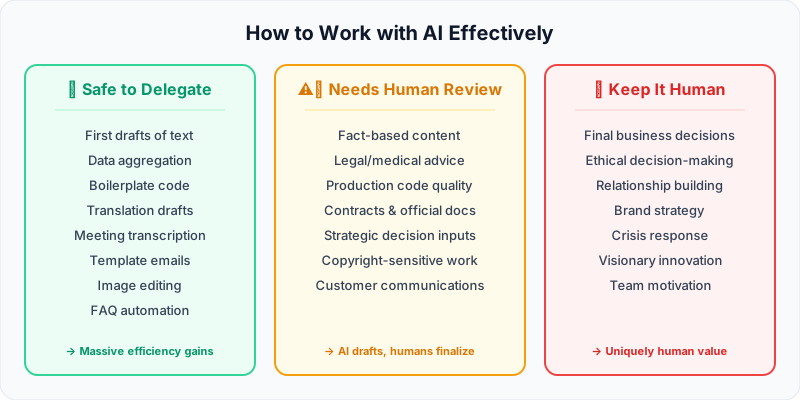
Adopting this mindset alone can transform how effectively you use AI. For specific implementation strategies, see our guide to AI-powered business efficiency.
6. The 2026 Frontier — Where AI Is Expanding
AI capabilities are evolving daily. Several areas previously considered "cannot do" are rapidly shifting toward "can do."
Multimodal AI
AI that simultaneously understands and generates text, images, audio, and video is advancing quickly. GPT-5.4, Claude Sonnet 4.6, and Gemini 3.1 Pro can answer questions about images and hold real-time voice conversations.
AI Agents
Beyond single-task execution, AI agents that autonomously plan and carry out multi-step tasks have entered production use. Browsing the web for research, understanding entire codebases — capabilities unthinkable just a year ago.
Reasoning Capabilities
The latest models like OpenAI's GPT-5.4 and Claude Opus 4.6 achieve scores in mathematical reasoning and logical thinking that rival human experts. The notion that "AI can't think" is rapidly becoming outdated.
Real-Time Information Access
Through web search integration, RAG (Retrieval Augmented Generation), and MCP (Model Context Protocol), AI's ability to access up-to-date information is improving rapidly. The old weakness of "AI only knows outdated information" is steadily being addressed.
7. Summary
AI isn't omnipotent, but used wisely, it's a powerful partner.
| Category | Details |
|---|---|
| Can Do | Text generation, image creation, coding, data analysis, speech recognition, workflow automation |
| Cannot Do | Emotional empathy, ethical judgment, true originality, factual guarantees, real-time info, physical tasks |
| Use with Caution | Legal, medical, financial, hiring, and creative tasks → always require human review |
The key is drawing a clear line between what AI handles and what humans own. Let AI take care of the repetitive work to free up time, so you can focus on the creative, strategic, and deeply human tasks that truly matter.
Want to build a solid AI foundation? Check out our AI introductory course. Curious about your AI proficiency level? Try our AI proficiency assessment.
FAQ
Will AI take all human jobs?
No. AI excels at pattern-based, repetitive tasks, but jobs requiring emotional intelligence, ethical judgment, and innovative thinking remain human. McKinsey's projections suggest very few occupations will be fully automated — most will see certain tasks become more efficient. Learn more in our AI job displacement guide.
Has the AI hallucination problem been solved?
It's improving but not solved. Even the latest models in 2026 show error rates of 5–15%. Key countermeasures: ① Verify important facts against primary sources, ② Use AI tools with built-in web search, ③ Always apply critical thinking to AI outputs.
Do I need programming skills to use AI?
Not at all. Major AI tools like ChatGPT, Claude, and Gemini work through natural conversation. Programming knowledge unlocks advanced features like code assistance, but basic use — writing, summarizing, research — requires zero technical background.
Can I use AI for free?
Yes. ChatGPT, Claude, and Gemini all offer free plans. Paid plans improve speed and expand usage limits, but getting started costs nothing. See our AI pricing comparison for details.
![15 Jobs Most Likely to Be Replaced by Generative AI — And How to Future-Proof Your Career [2026]](https://az-arte.com/images/articles/ai-job-loss-featured-en.svg)
![Generative AI Knowledge Cutoff Dates Compared: ChatGPT, Claude, Gemini & More [2026]](https://az-arte.com/images/articles/ai-cutoff-featured-en.svg)