![Is AI Destroying Blog Revenue? The Data Behind AdSense Decline & Survival Strategies [2026]](https://az-arte.com/images/articles/ai-adsense-impact-featured-en.svg)
Table of Contents
Many people started a blog dreaming of earning money through Google AdSense. But since 2025, the foundations of that model have been crumbling.
The cause is the rapid evolution of AI. Google's "AI Overviews" displaying AI-generated answers in search results, AI chatbots like ChatGPT and Claude changing search behavior, and a flood of AI-generated content — these three factors are simultaneously creating structural pressure on blog ad revenue.
This article uses research data as of April 2026 to show exactly how AI is impacting AdSense blog revenue, backed by concrete numbers.
1. What's Happening Right Now
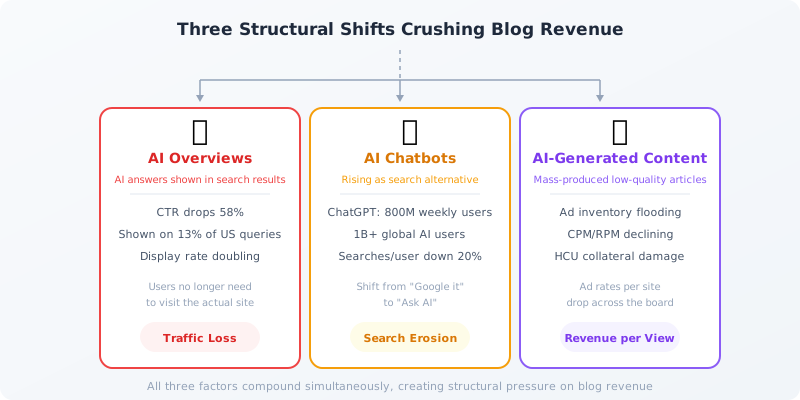
Blog revenue isn't declining for a single reason. Three structural shifts are happening simultaneously.
| Factor | Impact | Data |
|---|---|---|
| AI Overviews | AI answers directly on search results → fewer clicks to sites | CTR down 58% (Ahrefs study) |
| AI Chatbots | Replacing search → Google Search usage declining | Searches per user down 20% |
| AI-Generated Content | Mass-produced low-quality articles → ad inventory floods, CPM drops | RPM drops of 70–80% reported |
Let's examine each factor in detail.
2. AI Overviews Are Destroying Click-Through Rates
Google's "AI Overviews" (formerly SGE), fully rolled out in 2024, displays AI-generated answers at the top of search results. Users get their answer without clicking through to any blog, dramatically reducing traffic to publishers.
Impact on CTR (Click-Through Rate)
| Source | Metric | Result |
|---|---|---|
| Ahrefs (Dec 2025) | Average CTR drop for #1 page | 58% decrease |
| Seer Interactive (Sep 2025) | Organic CTR | 1.76% → 0.61% (61% decrease) |
| UK PPA | Lifestyle publisher | CTR 5.1% → 0.6% |
In other words, even if you rank #1 in search results, more than half of your clicks vanish when AI Overviews appear.
How Widely AI Overviews Appear
As of mid-2025, AI Overviews appear on 13.14% of all US desktop searches (Semrush study). This has doubled from 6.49% in January 2025, and the expansion is expected to continue.
While that's just over 10% of all searches, AI Overviews disproportionately appear on informational queries — exactly the type of content blogs specialize in — making the impact far more severe than the number suggests.
3. The Search Traffic Collapse
Beyond AI Overviews, the rise of AI chatbots is reducing Google Search usage itself.
Traffic Changes by Publisher
| Publisher / Metric | Change | Source |
|---|---|---|
| US publishers overall | Google search traffic -38% | Press Gazette |
| Global publishers overall | Google search traffic ~-33% | Press Gazette |
| News sites | Google referrals 51% → 27% (halved) | ppc.land |
| Forbes | Traffic -50% (Jul 2025 YoY) | The Digital Bloom |
| Business Insider | Traffic -40–48% | The Digital Bloom |
| Google searches per user | -20% | ALM Corp |
Even major media outlets are experiencing these declines. The impact on individual blogs is even more severe. NPR reported that some publishers describe this situation as an "extinction-level event."
AI Chatbot Growth
Behind the search traffic decline is the explosive growth of AI chatbots.
- ChatGPT: 800 million weekly active users (as of March 2025)
- Perplexity: 244% year-over-year growth
- Global AI users: Surpassed 1 billion (DataReportal, 2026)
- Behavioral shift: A 2025 survey found that more than half of respondents now open an AI app first when searching for information
AI chatbots still account for only about 3% of total search-equivalent queries, but the shift from "Google it" to "Ask AI" is accelerating rapidly, especially among younger users. For details on free AI services, see "How to Use AI for Free [2026 Guide]."
4. The Rise of Zero-Click Searches
"Zero-click searches" are searches where users get their answer on the results page without clicking through to any website. AI Overviews have accelerated this trend dramatically.
| Metric | Value | Source |
|---|---|---|
| Overall zero-click rate | 65% (mid-2025) | Up&Social |
| US zero-click rate | 58.5% | Semrush |
| With AI Overviews | 83% | Click Vision |
| News-related queries | 56% → 69% (2024→2025) | Similarweb |
Two-thirds of all searches result in zero clicks — this strikes at the very heart of the AdSense model (pageviews × ad rate = revenue). On queries where AI Overviews appear, 83% produce zero clicks. The gateway to blogs is disappearing.
5. AdSense RPM/CPM Decline
On top of traffic losses, the revenue per pageview (RPM/CPM) is also falling.
Reported Figures
- Publisher forums report eCPM/RPM drops of 70–80% since mid-2025 (SE Roundtable)
- In January 2026, a Google ad platform failure caused revenue drops of 50–90% overnight (confirmed as a Google bug)
- Average CPMs in 2026 for general sites: $0.30–$2. High-value niches (finance, health, tech): $5–$15
Structural Drivers of RPM Decline
The RPM decline isn't temporary — it's driven by structural factors.
- Third-party cookie deprecation: Reduced ad targeting precision lowers ad rates
- Privacy regulation expansion: Global Privacy Control (GPC) adoption restricts ad data usage
- AI-generated content flood: Low-quality sites massively increase ad inventory → suppresses overall CPMs
- Programmatic bidding shifts: Advertisers moving budgets toward mobile and video
These compounding factors mean display ad (AdSense) RPMs face a structural downward trend.
6. Google Grows While Publishers Shrink
The most ironic finding: while publisher revenues decline, Google's own ad revenue keeps hitting record highs.
| Metric | Value | Direction |
|---|---|---|
| Google Search ad revenue (Q4 2025) | $82.3B | +13.5% YoY |
| Google Search ad growth | +17% (Q4 2025) | Accelerating |
| Network ad revenue (AdSense etc., Q2 2025) | $7.4B | -1% YoY |
| Publisher traffic | — | -33–38% |
Understanding this structure is crucial. Google captures ad revenue through its own surfaces (AI Overviews, YouTube, Search itself) while paying less through the AdSense network to publishers.
In short, publishers are becoming less important to Google. If AI can provide answers directly, there's no need to send users to blogs.
7. Survival Strategies — Breaking Free from AdSense
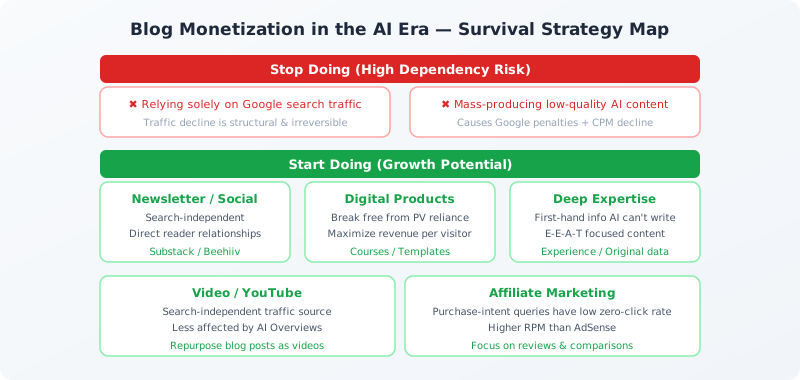
The data shows that surviving on display ads (AdSense) alone is becoming structurally untenable. So how should bloggers adapt?
1. From Search Dependence to Direct Reader Relationships
The most critical strategy is building traffic sources that don't depend on Google Search.
- Email newsletters: Build reader lists with Substack, Beehiiv, Ghost, etc. Immune to search algorithm changes
- Social media: Build presence on X (Twitter), Instagram, YouTube. Repurposing blog posts as videos is effective
- Push notifications: Drive return visits to your site
Dotdash Meredith's CEO explicitly stated that "cutting search reliance and embracing AI is paying off."
2. Diversify Revenue Streams
If AdSense RPMs are declining, you need to increase revenue per visitor through other channels.
| Revenue Source | PV Dependence | Earning Potential vs. AdSense |
|---|---|---|
| Affiliate marketing | Medium | RPM can be 10–50x higher |
| Digital products (courses, templates) | Low | Very high (90%+ margins) |
| Paid newsletters / subscriptions | Low | Stable, depends on list size |
| Sponsored content | Medium | Hundreds to thousands per post |
| Consulting | Low | High but limited scalability |
3. Create Content AI Can't Write
What kind of content won't be stolen by AI Overviews? First-hand information and real experience.
- Personal experience: Hands-on reviews, failure stories, success case studies
- Original data: Self-conducted surveys, experimental results
- Expert perspective: Content demonstrating E-E-A-T (Experience, Expertise, Authoritativeness, Trustworthiness)
- Community: Providing spaces for readers to interact (irreplaceable by AI)
4. Get Cited by AI Overviews
Instead of treating AI Overviews as the enemy, consider them a new traffic channel. Implementing structured data (Schema.org) properly can position your content as a source AI cites, building brand awareness even amid zero-click searches.
5. Action Steps for Today
- Check your Google Analytics search traffic trends — the decline may have already started
- Review your AdSense revenue over the past year — identify RPM decline patterns
- Start building an email list today — it will become your most valuable asset
- Add one new revenue source — affiliate marketing or digital products are the easiest to start
FAQ
Q. Is AdSense no longer profitable at all?
It's not that AdSense is completely dead, but the efficiency of the "write articles → rank in SEO → earn AdSense revenue" model has dropped dramatically. Informational queries ("what is...", "how to...") are hit hardest by AI Overviews. Branded keywords and niche topics with purchase intent may still work.
Q. Are AI Overviews shown outside the US?
Yes. AI Overviews have been expanding globally since 2024. While they currently appear less frequently than in English-speaking markets, expansion is expected to continue across all major languages.
Q. How reliable is this data?
The data cited in this article comes from major SEO and analytics platforms including Ahrefs, Semrush, Seer Interactive, Press Gazette, and Similarweb. However, each study uses different methodologies and sample sizes, so treat the numbers as directional trends. The impact on individual blogs varies significantly by niche and target keywords.
Q. Should I quit blogging?
You don't need to quit, but rethinking your revenue model is essential. Instead of relying solely on AdSense, build multiple income streams — affiliate marketing, digital products, newsletters, and more. A blog remains valuable as your own media platform; you just need to change how you monetize it.
Q. Can small blogs survive this?
Small blogs actually have an advantage in adaptability. You can start building an email list with free tools, and specializing in a niche helps you avoid competing directly with AI. While major media struggles, individual bloggers with close reader relationships have strong survival potential.
Q. Is LLMO effective?
LLMO (Large Language Model Optimization) is a technique for optimizing your content to be cited by AI chatbots and AI Overviews. It's gaining attention as a new approach alongside traditional SEO. For details, see "What Is LLMO?"
![15 Jobs Most Likely to Be Replaced by Generative AI — And How to Future-Proof Your Career [2026]](https://az-arte.com/images/articles/ai-job-loss-featured-en.svg)
![Generative AI Knowledge Cutoff Dates Compared: ChatGPT, Claude, Gemini & More [2026]](https://az-arte.com/images/articles/ai-cutoff-featured-en.svg)