Table of Contents
"Rank #1 on Google and you win" — that era is coming to an end.
As of November 2025, 83% of Google searches that display AI Overviews end with zero clicks — users don't visit any website at all. ChatGPT's monthly active users have surpassed 2.8 billion, and search behavior itself is shifting from "picking a link" to "asking AI."
The response to this shift is LLMO (Large Language Model Optimization) — the practice of optimizing your content so that AI systems cite and reference it in their answers. It's emerging as the next frontier of content strategy after SEO.
This article covers the fundamentals of LLMO, how it differs from SEO, specific techniques, and important risks to consider.
1. What Is LLMO?
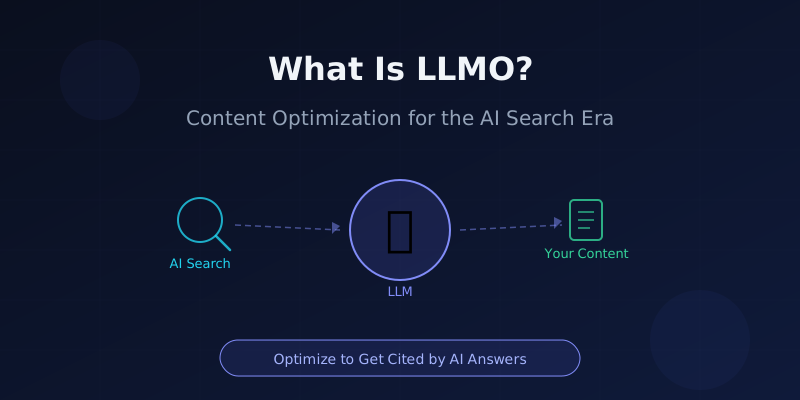
LLMO (Large Language Model Optimization) is the practice of optimizing your content so that AI systems like ChatGPT, Perplexity, Gemini, Claude, and Google AI Overviews cite and reference it in their generated answers.
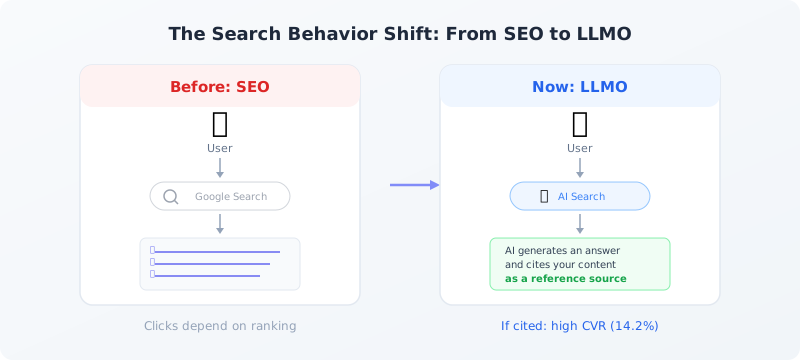
While traditional SEO aims to "rank higher" on search engine results pages, LLMO aims to be "included" in AI-generated answers.
Other Names for the Same Concept
LLMO is also known as GEO (Generative Engine Optimization), AEO (Answer Engine Optimization), and AIO (AI Optimization). They all refer to essentially the same concept. This article uses LLMO throughout.
The core of LLMO lies not in "whole-page ranking" but in whether individual passages of text get cited. LLMs retrieve information at the passage level — meaningful chunks of text — rather than ranking entire documents.
2. Why LLMO Matters Now
LLMO is rapidly growing in importance due to a fundamental shift in how people search for information.
The Explosive Growth of AI Search
ChatGPT's monthly active users have reached 2.8 billion (early 2026), and Google AI Overviews now reach 1.5 billion users per month. ChatGPT's search market share is estimated at 9–17%, making it the first search service other than Google to reach double-digit market share.
The Zero-Click Crisis
When AI Overviews appear in search results, the zero-click rate hits 83%, organic CTR drops by 61%, and paid CTR drops by 68%. Users are satisfied with AI answers and no longer click through to websites.
Gartner's Forecast
Gartner predicts that "by the end of 2026, 25% of organic traffic from traditional search engines will shift to AI chatbots and voice assistants."
Key Data Point
The conversion rate from AI search referrals is 14.2%, roughly 5 times higher than Google's 2.8%. While the traffic volume is still small, visitors from AI search tend to have more specific intent.
3. SEO vs. LLMO
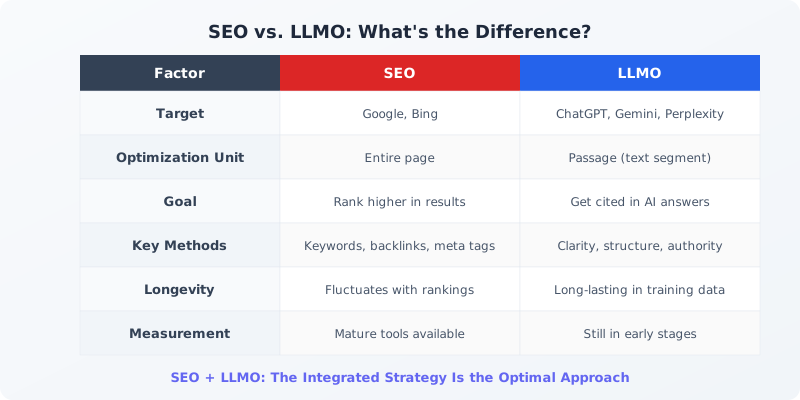
LLMO is not a "replacement" for SEO — it's an "extension." The recommended approach is an integrated strategy that adds LLMO on top of your SEO foundation.
| Factor | SEO | LLMO |
|---|---|---|
| Target | Google, Bing, etc. | ChatGPT, Gemini, Perplexity, etc. |
| Optimization Unit | Entire page | Passage (text segment) |
| Goal | Rank higher in search results | Get cited in AI answers |
| Key Methods | Keywords, backlinks, meta tags | Semantic clarity, structure, authority |
| Longevity | Fluctuates with ranking changes | Long-lasting if included in training data |
| Measurement | Mature tools available | Still in early stages |
SEO optimizes for "getting users to pick your link from a list." LLMO optimizes for "being included in AI answers." The two are complementary: SEO makes you discoverable, LLMO makes you citable.
4. 6 Key LLMO Techniques
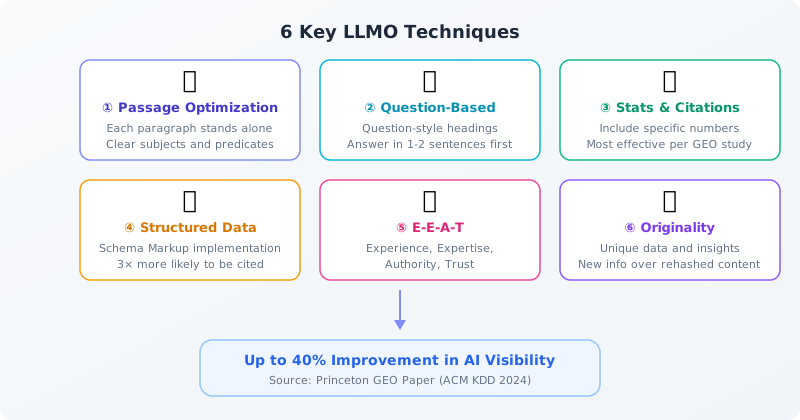
A research team from Princeton University and others published a GEO (Generative Engine Optimization) paper (accepted at ACM KDD 2024) that tested 10,000 queries and demonstrated that the following techniques can improve visibility in AI answers by up to 40%.
① Passage-Level Optimization
LLMs retrieve information at the passage level, not the document level. Each paragraph should make sense on its own, with clear subjects and predicates. Minimize pronouns like "this" and "that" — use specific nouns and concept names instead.
② Question-Based Content Structure
Create content that directly and accurately answers questions in the format users type into AI chatbots. Use question-style headings, answer clearly in the first 1–2 sentences, then expand with details.
③ Statistics and Citations
This was proven to be the most effective technique in the GEO paper. Including specific numbers, research findings, and source attributions dramatically increases the probability that an LLM will cite your information as "a trusted fact."
④ Structured Data (Schema Markup)
Pages with comprehensive Schema Markup are 3 times more likely to be cited in Google's AI Overviews. FAQ, Article, Organization, and Person schemas are particularly effective. Google officially confirmed the advantage of structured data in search results in April 2025.
⑤ E-E-A-T (Authority)
Demonstrating Experience, Expertise, Authoritativeness, and Trustworthiness makes LLMs prioritize your content as an information source. Author schema markup and robust organizational information are practical steps.
⑥ Original Information Value (Information Gain)
Rather than rehashing content available elsewhere, include original data, insights, and analysis unique to you. LLMs tend to prioritize unique information over repetitions of existing content.
5. Getting Started with LLMO Today
LLMO doesn't require a major site overhaul — you can start with your existing content today.
Step 1: Improve "Passage Quality" in Existing Articles
- Check that each paragraph makes sense on its own
- Replace pronouns ("this," "it") with specific nouns
- Maintain one topic per paragraph
Step 2: Add Statistics and Sources
- Support claims with specific numbers wherever possible
- Include survey names, organization names, and years
- Replace "it is said that..." with "according to a study by XX..."
Step 3: Add Structured Data
- Implement Article schema on article pages
- Add FAQPage schema to FAQ sections
- Set up Person schema for author information
Step 4: Monitor AI Visibility
- Regularly query ChatGPT, Perplexity, and Gemini with terms relevant to your business and check if your content is cited
- Consider adopting tools like Semrush's AI Visibility Toolkit
6. Risks and Considerations
Probabilistic Uncertainty
LLM outputs are probabilistic — the same query can produce different answers each time. Unlike SEO, you cannot deterministically "hold the #1 position." Even with optimization, citations are never guaranteed. Think of LLMO as improving probabilities, not ensuring outcomes.
Measurement Challenges
LLMs don't publish data equivalent to search volume, and hidden contextual factors influence answers. Established tracking tools are still scarce, making measurement significantly harder than with SEO.
Don't Abandon SEO
LLMO is an extension of SEO, not a replacement. AI search referral traffic still accounts for only about 1% of total web traffic, and Google search remains the dominant traffic source. The right approach is to maintain your SEO foundation while adding LLMO on top.
Content Quality Risk
Mass-producing shallow, formulaic content purely for AI optimization will backfire in both SEO and LLMO over the long term. The most important thing remains creating content that genuinely provides value to users.
FAQ
Which is more important, LLMO or SEO?
At this point, SEO remains more important. AI search traffic accounts for only about 1% of total web traffic, and Google search still drives the overwhelming majority of visits. However, AI search share is growing rapidly, and the recommended approach is to work on LLMO in parallel while maintaining your SEO foundation.
How do you measure LLMO effectiveness?
The basic approach is to regularly input business-relevant queries into ChatGPT, Perplexity, and Gemini to check if your content is being cited. Dedicated tools like Semrush's AI Visibility Toolkit are emerging, but measurement methodologies are not yet as established as those for SEO.
Can LLMO work for small websites?
Yes. Since LLMs prioritize accuracy, originality, and structure, large sites don't have an inherent advantage. If you provide high-quality content in a specific domain, small sites can absolutely be cited by AI. The GEO paper even reported that sites disadvantaged by traditional SEO tend to benefit more from LLMO.
When will LLMO become essential?
It's already growing in importance, but AI search visitors aren't expected to surpass traditional search visitors until around 2028. That said, first-mover advantage is significant in this space — the earlier you start compared to competitors, the better positioned you'll be.