The Speed of AI Evolution
Writing this chapter in March 2026, the AI industry's motto has become "six months ago is ancient history."
The numbers tell the story: AI-related investment hit $225.8 billion in 2025, an all-time record[1]. 77% of companies have deployed or are testing AI, and 21% of the world's population uses AI tools daily. The AI market is estimated at $244-391 billion in 2025.
Let's look at the major events of the past 18 months in chronological order.
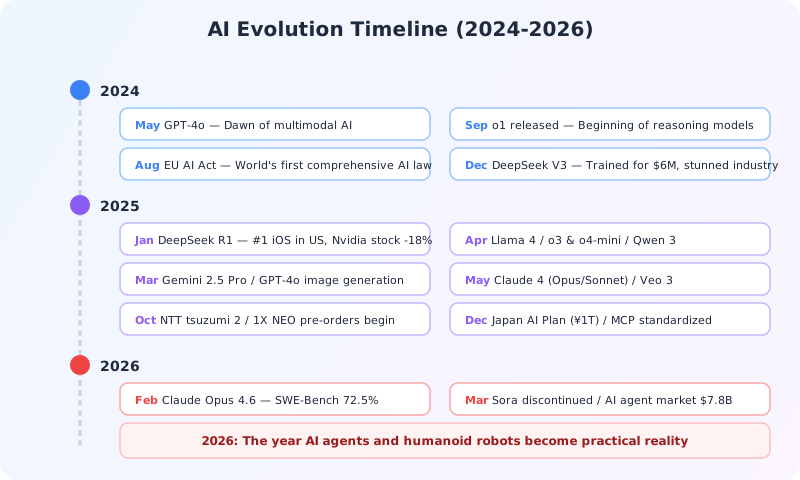
Now let's dive deep into four key trends.
Multimodal AI — AI with Five Senses
Multimodal AI refers to AI that can handle multiple formats — text, images, audio, and video — in an integrated way. Early LLMs could only read and write text. Today's AI can see images, hear speech, and create video.
2025 Breakthroughs
| Domain | Service | Capability |
|---|---|---|
| Image Generation | GPT-4o (native image gen.) | Accurately generates images with text. Demand was so intense at launch that Altman said GPUs were "melting" |
| Video Generation | Google Veo 3 | Generates video with audio. Over 270 million videos created since launch |
| Long Document Understanding | Gemini 2.5 Pro | Processes 1 million tokens (more than a full book) at once. Debuted #1 on LMArena |
| Voice Chat | GPT-4o Advanced Voice | Real-time natural voice conversation without text intermediary. Usable as a live interpreter |
Meanwhile, OpenAI's video generation AI "Sora" was burning an estimated $15 million per day in infrastructure costs, leading to its shutdown announcement in March 2026. This highlights the reality that high-quality video generation still comes with enormous costs.
Practical tip: Image analysis (photo → text) is available in free tiers across most services. Try it for everyday tasks like reading receipts, digitizing handwritten notes, or extracting data from charts.
The Reasoning Revolution — AI That "Thinks"
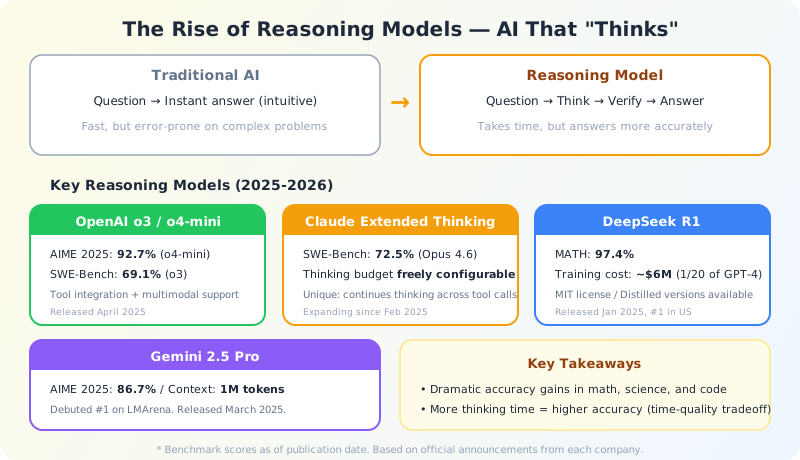
Starting in late 2024, a new AI category emerged: reasoning models.
Traditional AI responded to questions instantly. Reasoning models are different — they take time to "think" before answering. It's like how a human solving a math problem doesn't jump straight to the answer but works through it on paper, step by step.
Why It Matters
Reasoning models have dramatically improved AI performance in areas that were previously weak — mathematics, science, and complex programming.
- OpenAI o4-mini scored 92.7% on math olympiad-level problems (AIME 2025). With Python tools, 99.5%
- DeepSeek R1 achieved high performance at a training cost of just ~$6 million (compared to GPT-4's estimated $100M+), hit #1 on iOS in the U.S. in January 2025. Nvidia's stock temporarily dropped 18%[2]
- Claude Extended Thinking lets developers freely configure a "thinking budget" and features unique "interleaved thinking" that continues reasoning while using tools
Key insight: Inference-time compute.
The discovery that "giving AI more time to think produces more accurate answers" added a new dimension to AI progress. Beyond the traditional approaches of "more training data" and "bigger models," increasing computation at inference time also improves performance.
AI Agents — The Era of "Delegation"
The hottest keyword in 2025-2026 is AI agents.
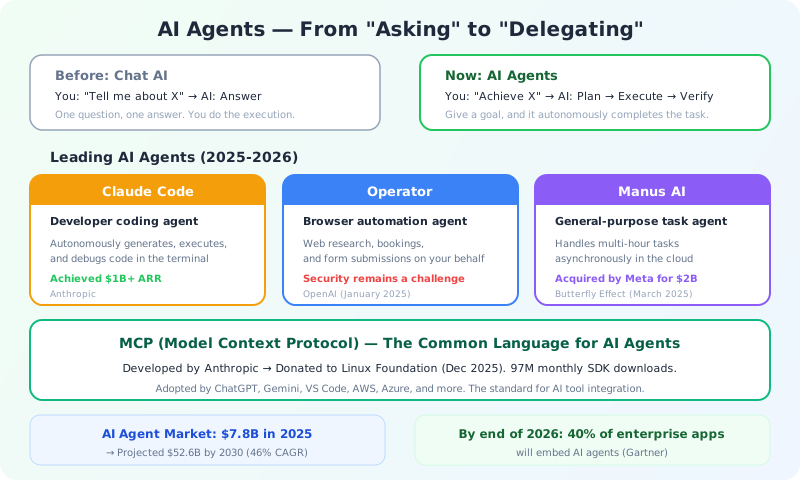
Previous AI was a conversation partner — you asked, it answered. AI agents are different. Give them a goal, and they plan, use tools, and autonomously complete tasks. It's like delegating work to an assistant or secretary.
AI Agent Examples
| Agent | Capabilities | Key Facts |
|---|---|---|
| Claude Code | Autonomously generates, runs, and debugs code end-to-end | One of three coding AI products to surpass $1B ARR |
| Operator | Controls web browsers to handle bookings and research | Includes human checkpoints, but prompt injection remains a challenge |
| Manus AI | Executes complex tasks asynchronously in the cloud | Launched March 2025; Meta acquired it for ~$2 billion shortly after |
| Devin | Autonomous AI software engineer | $500/month. Official success rate of 13.86% — still developing |
MCP — The "Common Language" for AI Agents
As a standard protocol for agents to interact with external tools, Anthropic's MCP (Model Context Protocol) has rapidly gained traction. Donated to the Linux Foundation in December 2025, monthly SDK downloads reached 97 million. ChatGPT, Gemini, VS Code, AWS, Azure, and other major platforms have all adopted it.
Gartner predicts that by the end of 2026, 40% of enterprise applications will have AI agents built in[1].
Agent limitations: Agents are powerful but have significant current constraints: complex reasoning errors, security risks (potentially sending information without authorization), cost (autonomous API calls add up), and accountability gaps. "Delegate, then verify" is the golden rule — not "delegate and forget."
The Rise of Open-Source AI
Commercial AI like GPT-4 and Claude isn't the whole story. Free, modifiable open-source AI is evolving at a remarkable pace.
Major Models (2025)
| Model | Developer | Key Features |
|---|---|---|
| Llama 4 Scout/Maverick | Meta | Scout: 10M token ultra-long context, runs on a single H100. Maverick: GPT-4o-competitive performance |
| DeepSeek V3/R1 | DeepSeek (China) | V3 trained for ~$6M, GPT-4o-class. R1 hit #1 in the U.S. as a reasoning model |
| Qwen 3 | Alibaba | Apache 2.0 license. Supports 119 languages. Surpassed Llama in downloads |
Why Open Source Matters
Open-source AI carries five key benefits:
- Transparency — Model mechanisms can be audited for safety
- Customization — Build specialized models with your own data
- Cost — Run on your own servers with zero API fees
- Privacy — Use AI without sending data externally
- Competition — Prevents AI monopolization by a few large companies
In summer 2025, a symbolic milestone was reached: Chinese-origin models (DeepSeek + Qwen) surpassed U.S.-origin models in total downloads. The geopolitical balance of AI development is shifting.
What this means for everyday users: Open-source AI is mainly for developers and enterprises, but its benefits reach everyone indirectly. As competition intensifies, commercial AI prices drop and performance improves. In fact, after DeepSeek R1's launch, multiple companies significantly cut their API pricing.
The Future of AI — 2026 and Beyond
AI x Robotics — Physical AI Becomes Real
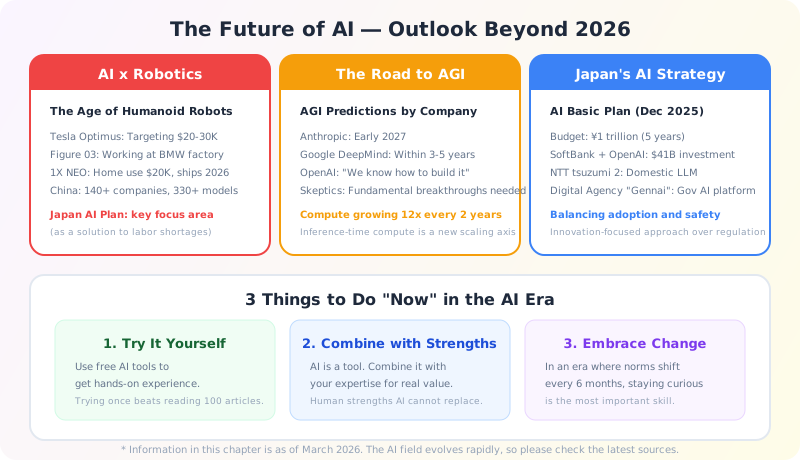
The combination of LLM intelligence and robotic bodies is bringing humanoid robots into real-world deployment.
- Figure 03 — Deployed at BMW factories. Over $1 billion in investment
- 1X NEO — World's first consumer humanoid robot. ~$20,000 ($499/month), shipping in 2026
- Tesla Optimus — Targeting mass production at $20-30K. Plans for tens of thousands of units in 2026
- Chinese manufacturers — 140+ companies, 330+ models in development
Japan's AI Basic Plan has designated "Physical AI" (robotics x AI) as a priority area for addressing labor shortages[3].
The Road to AGI — Expert Predictions
Opinions on when AGI (Artificial General Intelligence — AI with human-level or greater intelligence) will arrive vary widely within the industry.
| Perspective | Prediction |
|---|---|
| Anthropic | "Early 2027" — AI rivaling Nobel Prize-winning researchers by late 2026 / early 2027 |
| OpenAI | "We know how to build it" — Optimistic but avoids specific timelines |
| Google DeepMind | "Within 3-5 years" — Significantly moved up from the previous "10 years" estimate |
| Skeptical researchers | "Fundamental breakthroughs still needed" — 10-20 years on current trajectory |
Even if "AGI is coming" doesn't mean life will change overnight. But the fact that AI's capabilities expand virtually every month is undeniable. The assumption that "AI probably can't do that yet" may be outdated in six months.
What You Should Do Now
Three things to keep in mind
- Try it and get comfortable — Experiment with free AI tools. Trying is worth a thousand articles
- Combine AI with your strengths — AI is a tool. Your expertise and creativity, combined with AI, create real value
- Embrace the change — In an era where yesterday's common sense is tomorrow's old news, staying curious is the ultimate skill
References
- Gartner. "Worldwide AI Spending Will Total $1.5 Trillion in 2025." Gartner Newsroom, September 2025. / Fortune Business Insights. "Artificial Intelligence Market Report." 2025.
- "DeepSeek R1: Open-source reasoning model." DeepSeek API Docs, January 20, 2025. / Market impact reported by multiple financial outlets, January 27, 2025.
- "Japan adopts first AI basic plan with 1 trillion yen investment." Nikkei, December 2025. / "Japan AI Basic Plan." AI Strategy Headquarters, December 2025.
Related links:
- Hugging Face Models — Hub for open-source AI models
- LM Arena — Leaderboard for comparing AI model performance
Congratulations on completing all 6 chapters!
You've built a solid foundation of knowledge spanning AI fundamentals to the latest trends. AI evolves daily. Use what you've learned here as your foundation, keep experimenting with tools, and stay up to date with the latest developments.